- Oct 29
Dyslexia, DLD, or Both: How to Identify Them and Support Them at Every Tier
- Britney | Language and Literacy Clinic of Manitoba
- 0 comments
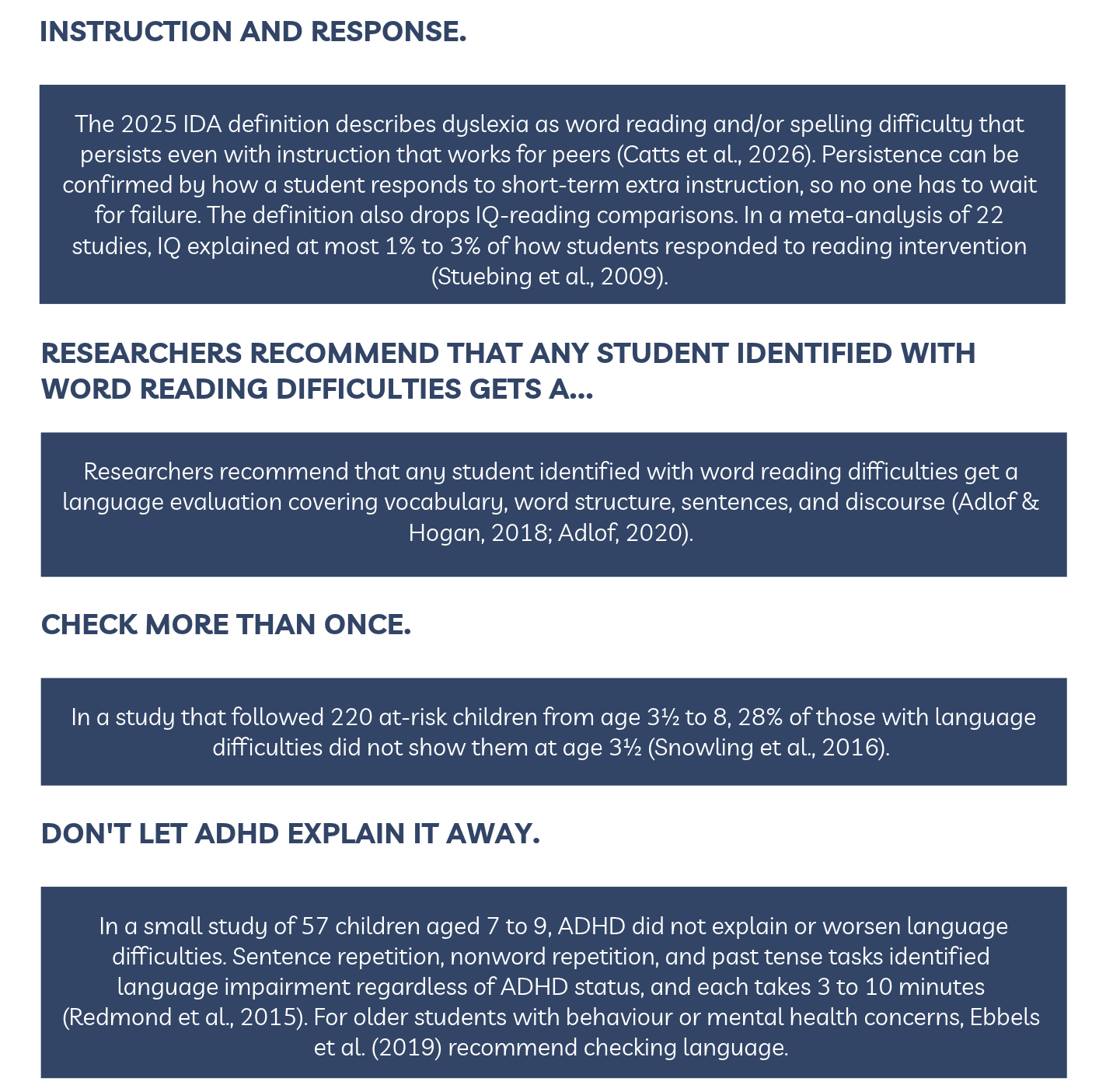
A student who reads words accurately can pass every reading screener in your building and still have a language disorder. In one study of 448 students in Grades 2 to 4, students with developmental language disorder (DLD) who read words well were the least likely to have ever received special education services: only 7% to 14% (Duff et al., 2020, as reported in Adlof, 2020).
This post covers two questions: how to identify dyslexia, DLD, or both, and what support looks like at each tier of MTSS.
Why these students get missed
About 7.58% of children start school with a language disorder that has no known cause, roughly two students in a class of 30. Fewer than 40% of them had extra school support (Norbury et al., 2016).
Dyslexia and DLD are different. Dyslexia mainly affects reading words. DLD mainly affects understanding and using language. They often occur together, and both lead to weak reading comprehension for different reasons. Students with both have the most difficulty (Snowling et al., 2020).
Most school screening and RTI systems were built around word reading (Adlof, 2020). A student who decodes well can look fine until comprehension demands rise. In one longitudinal study, about 40% of kindergarteners with language difficulties who later had reading problems didn't show them until Grade 4 or later (Catts et al., 2012, as reported in Adlof, 2020).
Tier 1: Classroom supports
Strong core instruction is now part of identification, because the definition asks whether instruction works for peers.
For content-area vocabulary, try Word Discovery (Lowe et al., 2019). Science teachers in 8 secondary schools used it with 78 students aged 11 to 14 with language disorder after one hour of training:
- Display a picture with the written word.
- Model being a word detective: look at word parts, use context, ask someone, check a dictionary.
- Build word maps: syllables, first sound, rhymes, and word parts, plus function, location, parts, category, and a personal link.
- Do quick oral practice: meaning, a sound clue, and the word in a sentence.
- Play sound and meaning bingo and keep a key word sheet.
Students learned up to two more words out of 10 than with usual teaching. The study had no separate control group, and the advantage faded after five weeks without review, so build in regular review.
For sentence-level language, see our Syntax Guide. It walks educators through research-grounded syntax instruction across Tier 1, Tier 2, and Tier 3.
Tier 2: Small-group supports
Group by profile. Students with dyslexia need decoding support. Students with DLD need language support. Students with both need both (Adlof & Hogan, 2018; Snowling et al., 2020).
Foundational reading groups. A meta-analysis of 53 studies with 6,053 K to 5 students with or at risk for dyslexia found reading intervention worked (g = 0.33). Groups averaged 3 to 4 students, and group size did not change results. More hours led to slightly larger gains, with an average of 55 hours (Hall et al., 2023).
Oral language groups. In a randomized controlled trial with 358 Grade 7 students, trained teaching assistants ran groups of 2 to 6 students for 45 to 60 minutes, 3 times a week, for 6 weeks. Storytelling improved, but vocabulary did not improve on standardized tests. The assistants had 4 days of training plus weekly support, and the authors said longer intervention is likely needed (Joffe et al., 2019).
Keep records that count. Log hours actually delivered, group size, and progress monitoring data. Under the 2025 definition, that record is identification evidence. For K to 3 language progress monitoring, Adlof (2020) names the Narrative Language Measures, while noting that language monitoring tools are still limited.
Tier 3: Intensive and one-to-one supports
Add time. The gain per extra hour in Hall et al. (2023) was small, so more time is a reason to intensify, not a promise of big jumps.
Keep going with older students. For struggling readers in Grades 4 to 12, interventions shorter than a school year produced about a year's growth, though gains on standardized tests were smaller (Scammacca et al., 2015).
Match who delivers to the need. Ebbels et al. (2019) describe Tier 3A, where an SLP plans support and educators deliver it. This works for milder needs when staff are trained, supported, and monitored. Tier 3B is direct SLP intervention for complex or pervasive needs.
Decide on one-to-one with data. Group size did not change results in Hall et al. (2023), but that does not prove a small group is enough for every student. Let progress monitoring guide the decision.
Support the adults, too
In a meta-analysis of professional development for early childhood educators, courses alone had no significant effects, while courses plus coaching and feedback had larger effects (Markussen-Brown et al., 2017, as reported in Ebbels et al., 2019). When language programs were scaled up with less support, effects shrank or disappeared.