
About LLCM
We work with schools and educators who believe every student deserves reading instruction that actually works — and we help them make that happen.
OUR APPROACH
Language and Literacy Clinic of Manitoba supports educators by making the Science of Reading understandable, practical, and usable in real classrooms. We take complex research and turn it into clear, structured professional learning that builds strong literacy foundations.
We work alongside teachers, school teams, literacy coaches, and division leaders to strengthen Tier 1 instruction, improve data-based decision-making, and build systems that last beyond a single PD day.
Our goal is simple: equip educators with the knowledge and tools they need so every student has the opportunity to become a skilled reader.
MEET BRITNEY
MSc, S-LP(C), R.SLP
Britney Morrish is a Speech-Language Pathologist, educational consultant, and the founder of Language and Literacy Clinic of Manitoba. She has spent her career working at the intersection of language, literacy, and educational systems — supporting students with complex profiles and training the educators and school teams who work alongside them.
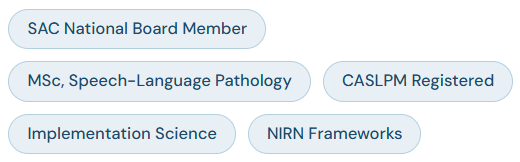
Britney holds a Masters of Science in Speech-Language Pathology and is registered with the College of Audiologists and Speech-Language Pathologists of Manitoba (CASLPM) and Speech-Language and Audiology Canada (SAC). She currently serves on the SAC national board, where her work includes strategic planning and policy development.
What sets LLCM's work apart is a commitment to implementation science — the study of how evidence-based practices are adopted, sustained, and scaled within real systems. Drawing on frameworks from the National Implementation Research Network (NIRN), LLCM does not just deliver professional learning and leave. We work with school and division teams to build the conditions, coaching structures, and shared knowledge needed for new practices to take root and hold.
Britney's professional development supports have reached teachers, literacy coaches, SLPs, and school leaders worldwide. She is known for making the Science of Reading practical, not just theoretical.

She has been featured in the Winnipeg Free Press, the Brandon Sun, contributed to the Manitoba Literacy Alliance position statement, served on the Speech-Language and Audiology Canada board of directors, and has appeared on the SLP Coffee Talk and Speechy Side Up podcasts.
about Language and Literacy Clinic of Manitoba
We are not a program.
And we are not a one-time PD event.
We work alongside school and division teams to build the knowledge and systems needed to make structured literacy work in real classrooms.
That means:
Understanding how the brain learns to read
Building strong phonics and language instruction
Using data to group students effectively
Planning for intervention within real schedules
Supporting teachers as they implement
We combine professional learning, classroom modelling, coaching, and ongoing support.
Our goal isn’t inspiration.
It’s implementation.
Please visit our "Work with Us" page to find out more.
We provide practical systems that work inside real schools.
This includes:
Guidance on choosing and using universal screeners
Training on interpreting data for decision-making
Building flexible, skill-based groups
Designing intervention blocks that fit within your schedule
Coaching teams through real student scenarios
Data should reduce overwhelm, not create it.
We help your team use data with clarity and confidence.
Visit our "Work with Us" page to book a free 20-minute discovery call to find out more.
Structured literacy and MTSS should work together, not compete.
We help schools align Tier 1, Tier 2, and Tier 3 instruction by:
Strengthening core instruction
Building clear decision rules for grouping and movement between tiers
Designing intervention blocks that fit within existing schedules
Training teams to use screening and progress monitoring data effectively
Strong Tier 1 reduces pressure on intervention.
Clear systems reduce staff burnout.
We understand that each child, each intervention group, each classroom is unique, so when we train educators we customize our approach to fit their needs while making sure to follow best practices.
Our goal is to bridge the gap between research and everyday teaching. We do the heavy lifting, staying on top of the latest findings, so you don't have to spend hours reading research articles. With us, you can trust that you're getting the most current and effective methods to support your team.
Yes!
Our courses can all be found on our website.
You can work 1-1 with us completely virtually - find out more on our "Work with Us" page.
We work directly with schools, districts, homeschool groups, parent groups (etc.) to provide trainings. These can be offered in-person or virtually.
Literacy success requires consistency.
Through data-based decision-making, we support leadership teams to:
Clarify non-negotiables for phonics and language instruction
Build shared instructional language across schools
Develop practical implementation plans
Monitor response to instruction
Support teacher leaders and literacy leads
Provide ongoing coaching and access for questions
Our role is to help you build internal capacity so your team can make informed, consistent decisions long after the PD ends.