- May 25
When Students Can Decode But Can't Comprehend: What Inferencing Has to Do With It
- Britney | Language and Literacy Clinic of Manitoba
- 0 comments
There is a student in many classrooms who reads the words on the page accurately and still cannot tell you what the passage was about. This pattern is common, and it is also commonly misunderstood.
Comprehension breaks down for a lot of reasons. Weak decoding is one of them. Limited vocabulary is another. Syntax can get in the way, especially for students with Developmental Language Disorder (DLD). Background knowledge matters too. If you missed our previous posts on what works for DLD and dyslexia and this one on supporting reading comprehension through explicit instruction head back over there to lay the groundwork before diving into this post.
Today's blog is about one specific piece of comprehension that often gets overlooked: inferencing, and specifically, the process of building what researchers call a mental model.
What Is a Mental Model?
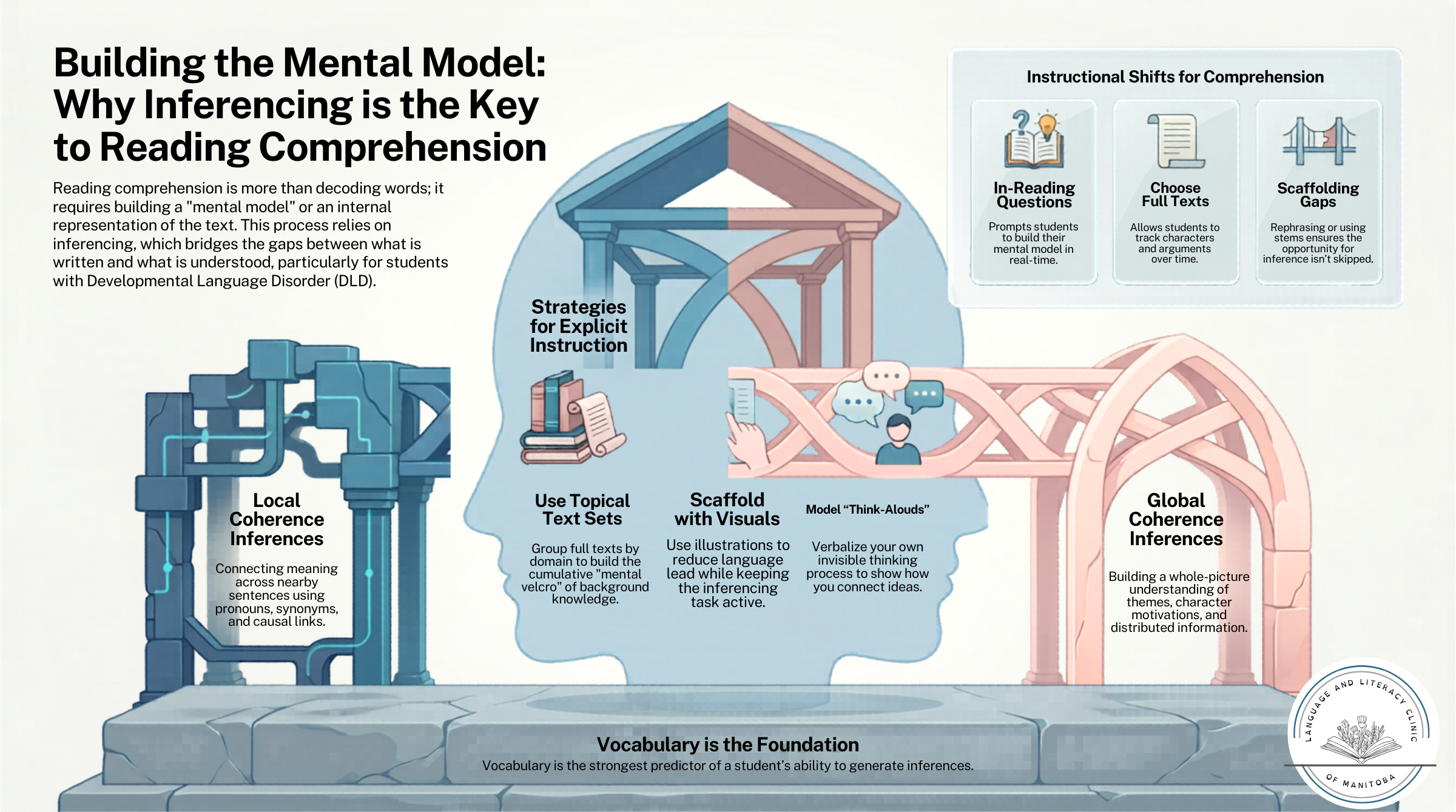
When a reader processes a text, they are not simply converting words into sounds. They are constructing an internal representation of the situation the text describes: who is involved, what is happening, why events unfolded the way they did, and how the pieces connect across the whole passage.
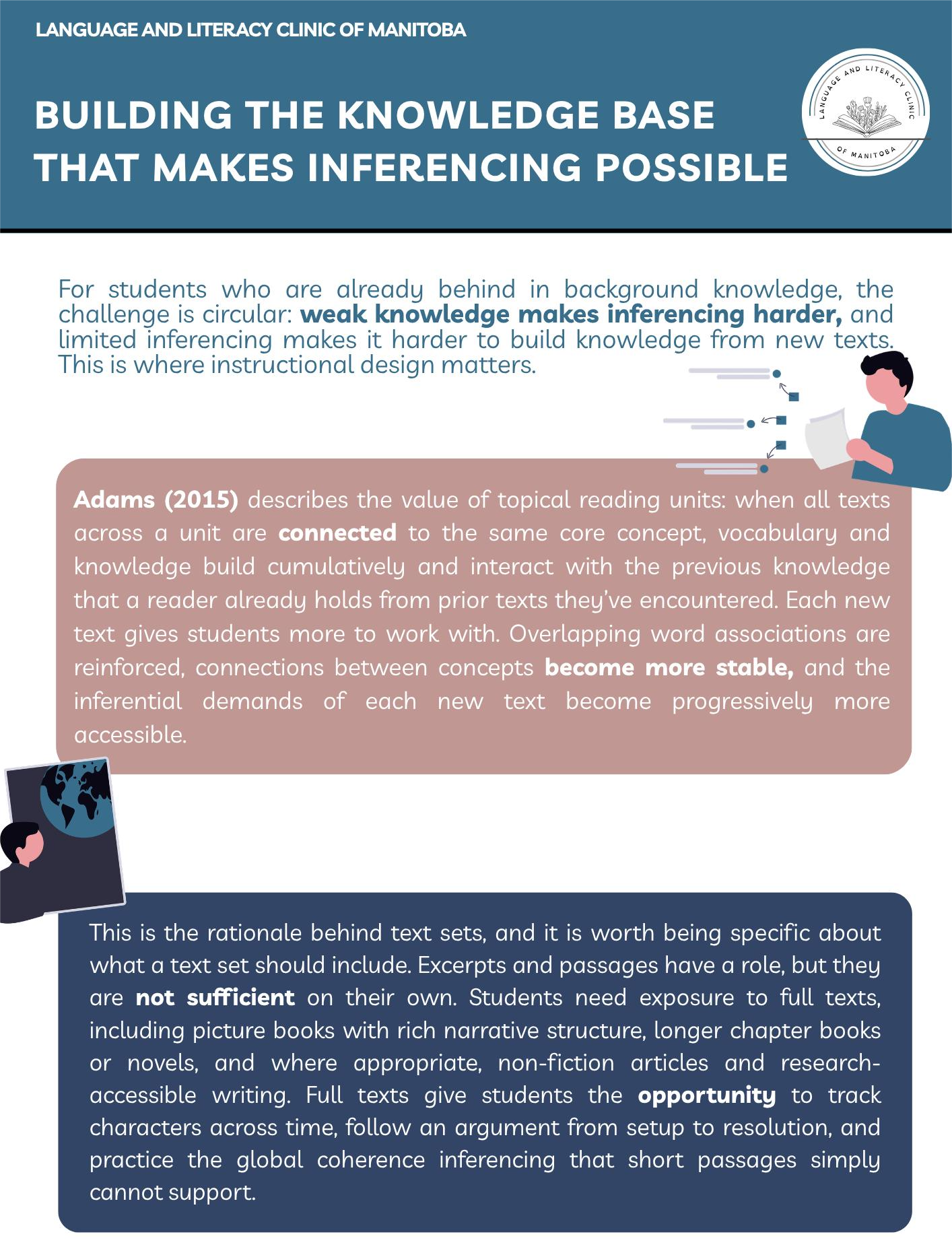
Researchers van Dijk and Kintsch (1983) described this as a situation model. Albrecht and O'Brien (1993) demonstrated that readers actively work to maintain both sentence-level and whole-text coherence as they read, checking new information against earlier content even when that content is no longer in immediate working memory. This is what Marilyn Jager Adams was referring to when she said background knowledge acts as "mental velcro". Our previously-existing knowledge is constantly changed and updated in real time, as we read.
When a reader encounters a familiar word, it automatically activates the entire network of associations that word has built up through experience: sensory memories, related concepts, contexts, patterns of use. As each successive word in a sentence is processed, the overlapping associations between words effectively become activated, reinforcing and clarifying meaning in real time. Comprehension is not something that happens at the end, after the reading task has been completed. We build meaning word-by-word as we read a text.
The flip side of this is equally important. When a reader cannot recognize a word at all, they lose not only that word's meaning but also the contextual work that word was supposed to do for every other word around it. And when a reader recognizes a word but has limited knowledge of its meaning and usage, their understanding is correspondingly limited. Adams puts it plainly: knowledge is the medium of understanding, and therefore of reading with understanding (Adams, 2015).
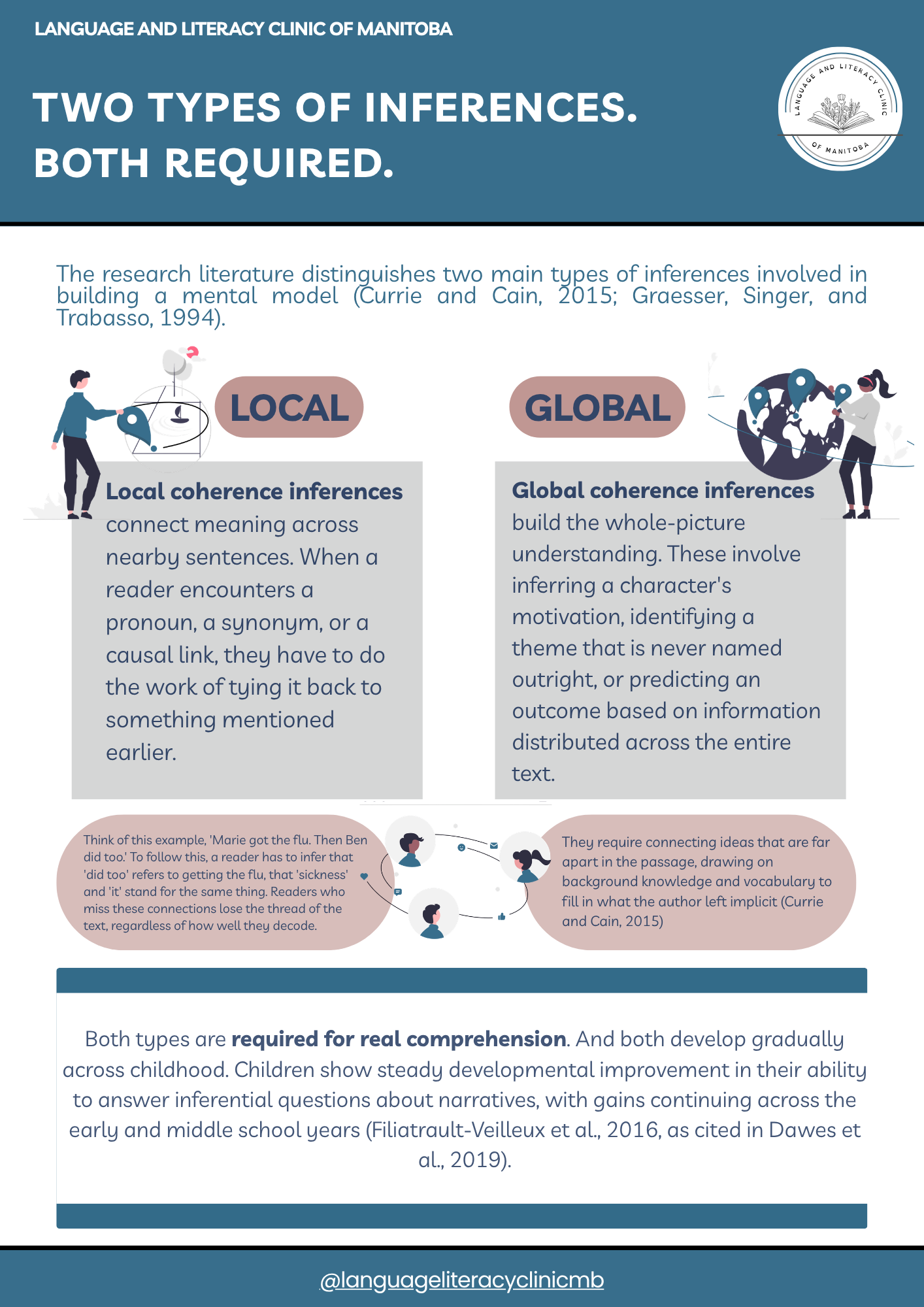
This matters for inferencing because inference generation is not a separate skill that sits on top of language. It runs through it. A reader who lacks the vocabulary or domain knowledge relevant to a text cannot make inferences from gaps they do not have the resources to fill. The mental model cannot be built without the raw materials.
Why This Matters for Students With DLD
Children with DLD consistently show weaker inferential comprehension than age-matched peers, and this has been documented across multiple age groups and study designs (Bishop and Adams, 1992; Norbury and Bishop, 2002; Botting and Adams, 2005, as cited in Dawes et al., 2019). As we have written about before, DLD affects a broad range of language skills, and inferencing is one area where the impact on reading comprehension can be significant.
Poor inferential comprehension affects more than reading scores. Dawes and colleagues (2019) note that it affects a student's ability to follow the flow of peer conversations and classroom discourse, and to access the written language demands of academic settings. And Silva and Cain (2015) found that oral inferential comprehension in the early years is a significant predictor of later reading comprehension.
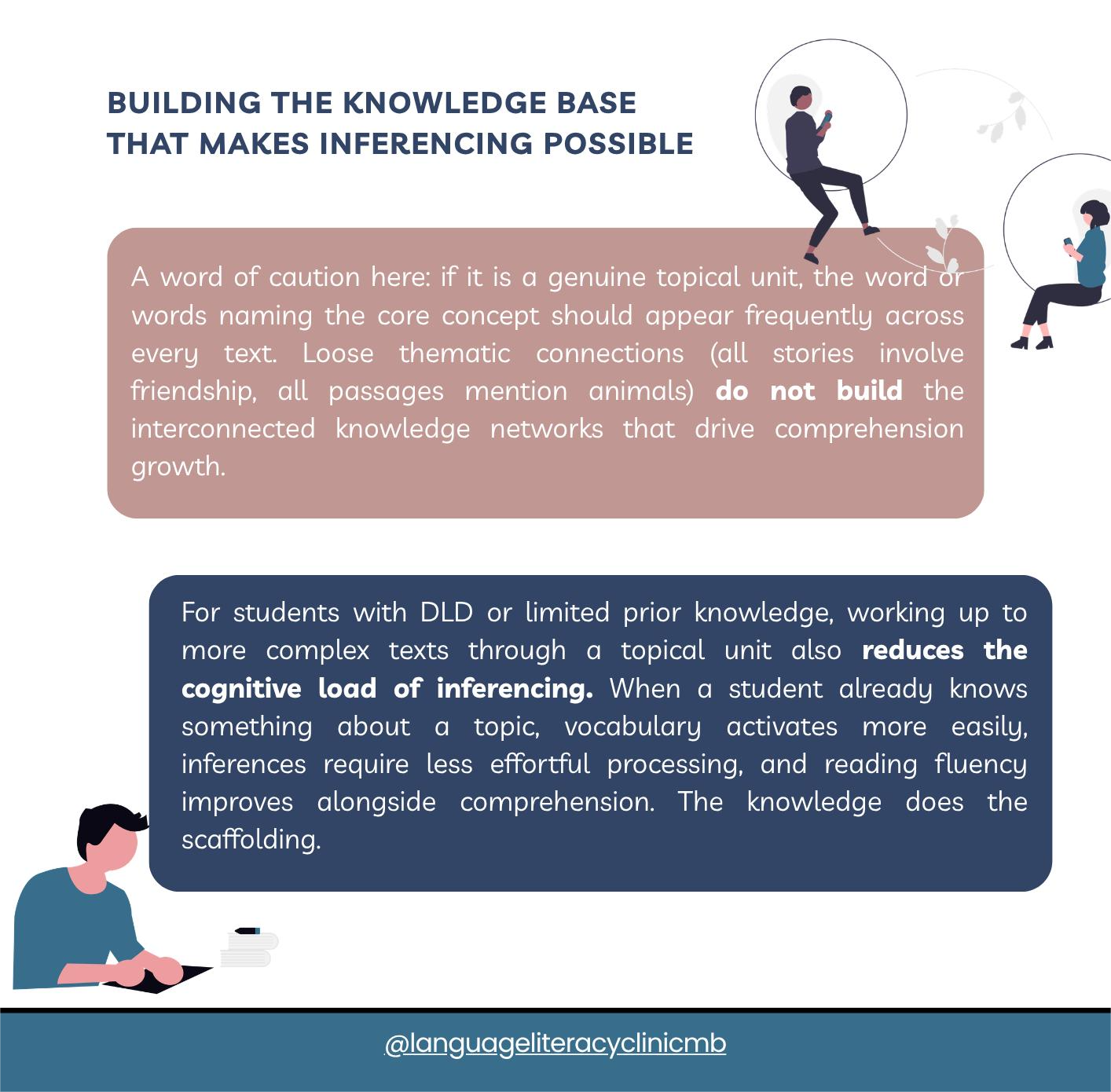
Inferencing difficulty is not the only reason a student with DLD might struggle with comprehension, and it is not always the primary one. Vocabulary gaps, syntactic difficulties, and working memory demands all interact with inferencing. Currie and Cain (2015) found that vocabulary was the strongest unique predictor of both local and global coherence inference generation in children aged 5 to 10, and that vocabulary mediated the relationship between working memory and inferencing. Vocabulary instruction that builds depth, not just breadth, is also inferencing instruction.
Inferencing Is a Skill That Can Be Directly Taught
If your students are struggling with inferencing, it is not a fixed trait. It responds to explicit instruction.
For SLPs and Classroom Teams
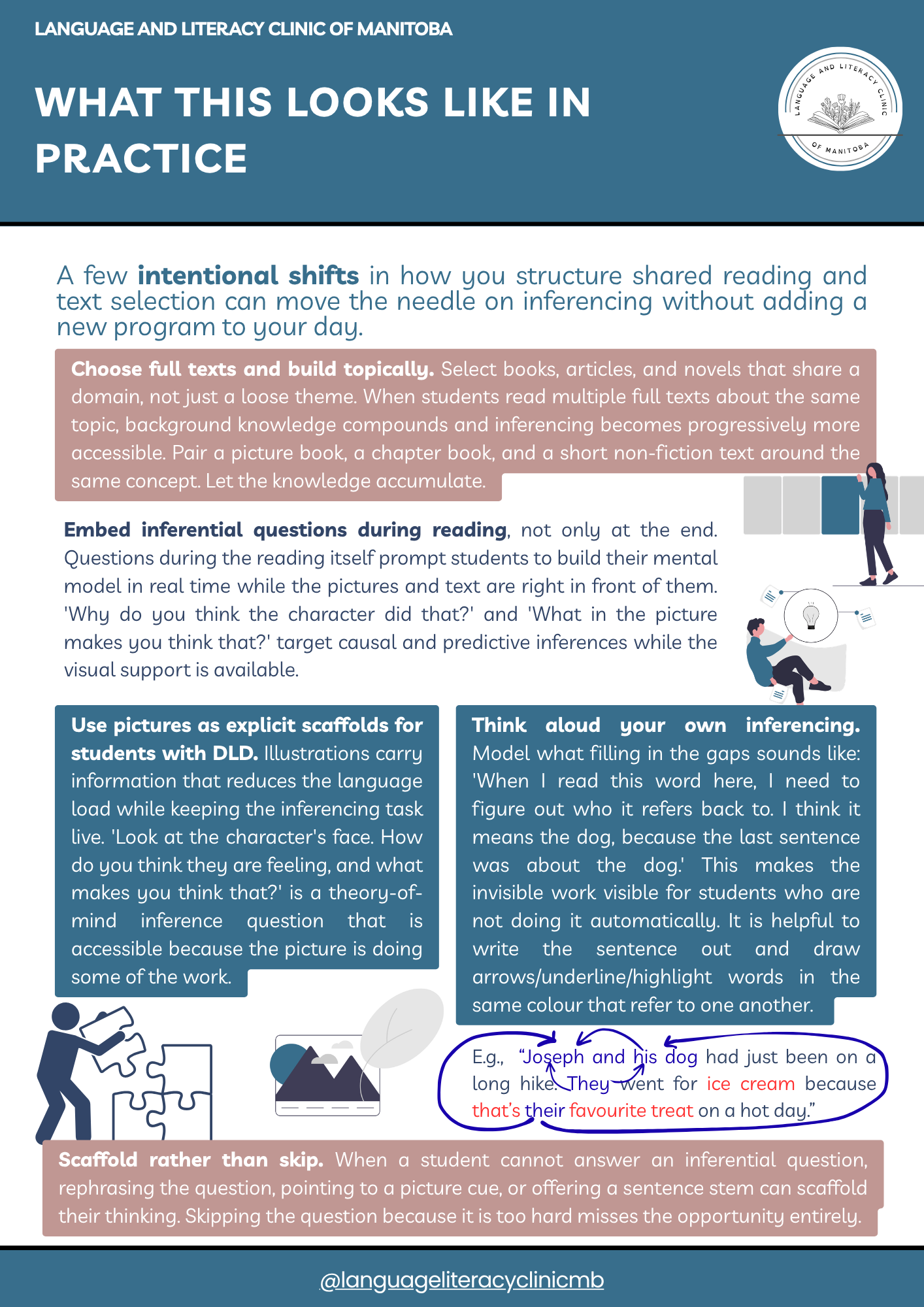
If you are an SLP working in schools and you have students with DLD on your caseload, inferencing goals belong in your program alongside vocabulary, syntax, and narrative language work. The evidence base for targeted inferencing intervention with this population is strong, and it does not require expensive materials. Well-chosen picture books, scripted questions, and consistent scaffolding are relatively simple to incorporate into sessions.
If you are a classroom teacher, the read-aloud is already in your day. Embedding two or three inferential questions during the reading, pointing to the pictures, and thinking out loud about what you are inferring costs nothing and builds exactly the skills your learners need to build a strong mental model.
If you are looking to build a more systematic approach to inferencing and mental model instruction across your school or division, we support teams through professional development and coaching. Contact us to find out what that looks like.
____________________________________________________________________________________________
References
Adams, M. J. (2015). Knowledge for literacy. Shanker Institute / Core Knowledge Foundation. [Blog post adapted from Literacy Ladders anthology]
Albrecht, J. E., & O'Brien, E. J. (1993). Updating a mental model: Maintaining both local and global coherence. Journal of Experimental Psychology: Learning, Memory, and Cognition, 19(5), 1061-1070.
Currie, N. K., & Cain, K. (2015). Children's inference generation: The role of vocabulary and working memory. Journal of Experimental Child Psychology, 137, 57-75.
Dawes, E., Leitao, S., Claessen, M., & Kane, R. (2019). A randomized controlled trial of an oral inferential comprehension intervention for young children with developmental language disorder. Child Language Teaching and Therapy, 35(1), 39-54.
Silva, M., & Cain, K. (2015). The relations between lower and higher level comprehension skills and their role in prediction of early reading comprehension. Journal of Educational Psychology, 107, 321-331.
van Dijk, T., & Kintsch, W. (1983). Strategies of discourse comprehension. Academic Press.