- Apr 6
When Language and Dyslexia Collide: Supporting Reading Comprehension through Explicit Instruction
- Britney | Language and Literacy Clinic of Manitoba
- 0 comments
Teaching for Language Load in Students With DLD and Dyslexia
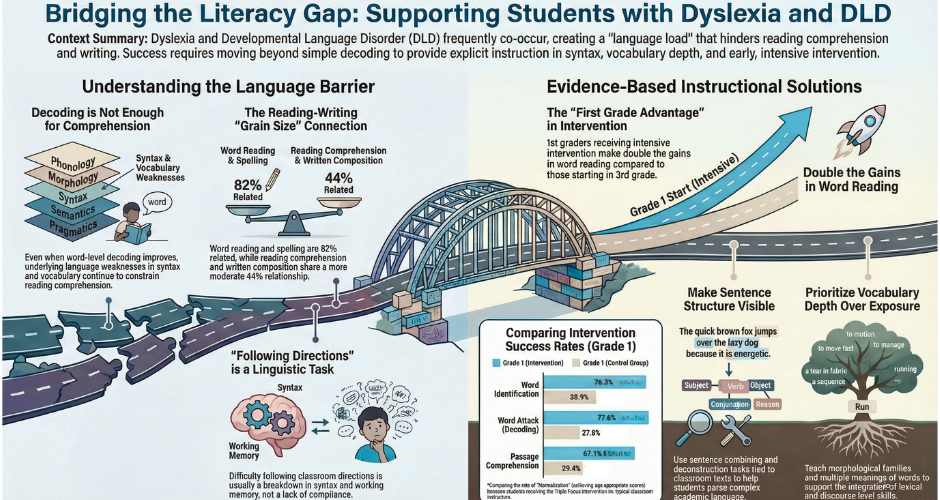
In schools, students with comorbid developmental language disorder (DLD) and dyslexia are often described as having vague comprehension problems: they don’t follow directions, they miss the point, they struggle with multi-step tasks, or their processing is slow. These descriptions are familiar, but they’re not very helpful. Unfortunately, they can obscure what’s actually breaking down.
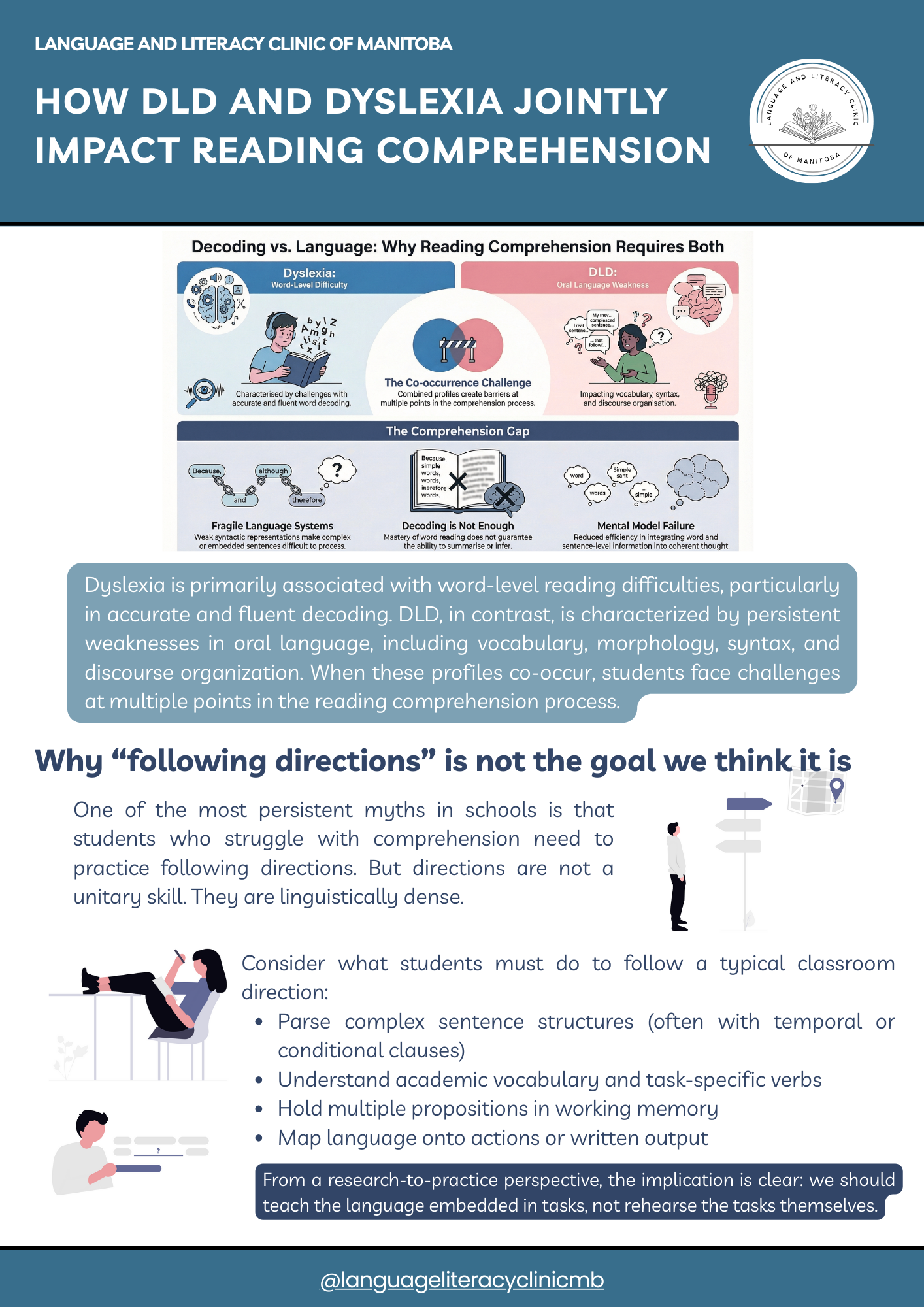
The research is clear that DLD and dyslexia frequently co-occur, and when they do, their effects on reading comprehension are not simply additive. Instead, language and word-level difficulties interact in ways that place extraordinary demands on students’ linguistic systems, especially syntax, vocabulary, and discourse-level language (Snow, 2020).
This post unpacks how these comorbid profiles affect reading comprehension and what educators can do instructionally to support students to work with complex language rather than endlessly simplifying it.
Teaching for language load: What helps reading comprehension
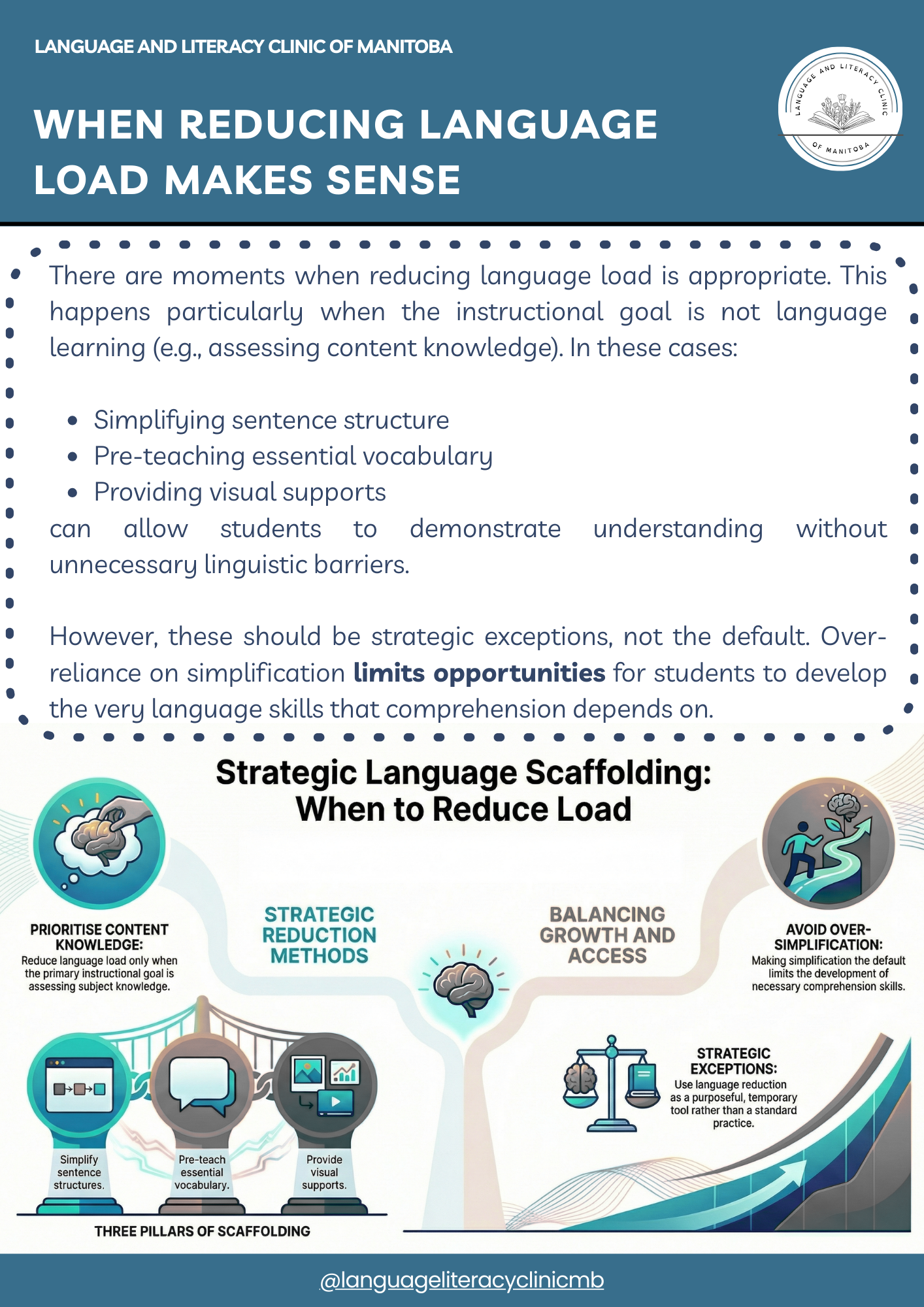
Rather than reducing linguistic complexity across the board, the evidence supports explicit instruction that helps students understand and use complex language with scaffolds in place.
1. Make sentence structure visible
Students with DLD often struggle with embedded clauses, passive constructions, and dense noun phrases—structures that are extremely common in curriculum texts and academic discourse. So when a student with DLD’s teacher is giving an instruction or teaching an important concept, that student is often left behind.
Effective classroom practices include:
-
Explicitly and systematically teaching sentence structure inside and outside of texts
Check out The Syntax Project https://thesyntaxproject2022.squarespace.com/access to find free syntax-based lessons.
-
Teaching students to identify “who did what to whom” in complex sentences
A key component of high-quality syntactic instruction and intervention is explicit metalinguistic instruction - i.e., talking about language structures in a way that “fills in the gaps” for students who have missed this instruction or may have impaired language.
-
Using sentence combining and deconstruction tasks tied directly to classroom texts
It is important to always link language to content and knowledge. Language is the structure by which we learn new information, it should not be taught in isolation.
These approaches align with an emphasis on oral language as a driver of reading comprehension and support students in building syntactic representations that transfer across contexts (Snow, 2020).
2. Teach vocabulary for depth, not exposure
Vocabulary instruction for students with DLD and dyslexia must go beyond definitions. Research consistently shows that vocabulary depth supports comprehension more strongly than breadth alone.
High-impact practices include:
Teaching multiple meanings and morphological families of words
Explicitly linking vocabulary to sentence and discourse contexts
Revisiting vocabulary across reading, writing, and oral discussion
This kind of instruction supports the integration of lexical and discourse-level skills identified by Kim et al. (2023) as critical for comprehension and written expression.
Feeling lost when it comes to vocabulary instruction?
Use code BLOG25 to get 25% off our vocabulary masterclass until June 30, 2026.
3. Break tasks by language demands, not steps
Complex tasks are often broken down procedurally (first do this, then that). For students with language-based learning disorders, it is often more effective to break tasks down by linguistic demand:
What language must be understood?
What language must be produced?
Where does syntax or vocabulary change across the task?
For example, when assigning a multi-part written response, teachers can explicitly teach the sentence frames, discourse markers, and verb forms required—before students are expected to use them independently.
Why ongoing literacy coaching and PD matter
The instructional shifts described above are not achieved through one-off professional development sessions. Research on reading intervention and instructional change consistently shows that sustained, linguistically informed instruction—supported by coaching—produces stronger and more durable outcomes.
Studies examining early and intensive reading intervention highlight the importance of teacher knowledge, instructional precision, and responsiveness to individual differences (Lovett et al., 2017). These conditions are far more likely to be met when educators have access to:
Ongoing coaching
Opportunities to analyze student language and literacy data
Support translating research into daily instructional decisions
From a practice standpoint, literacy coaching adds value by helping educators move beyond labels (“can’t follow directions”) to instructionally actionable explanations grounded in language and reading science.
Did you know we offer ongoing literacy coaching and PD to all levels of educators? From Educational Assistants and Teachers to Clinicians and Administrators, we’ve got you covered. Contact Us to find the right PD for you and your team.
Bringing it together
When DLD and dyslexia co-occur, reading comprehension difficulties reflect deep linguistic challenges—not a lack of effort, attention, or motivation. The research supports an instructional response that is explicit, language-focused, and sustained over time.
For administrators, SLPs, and educators, the takeaway is not that we should make reading easier, but that we should teach the language that reading requires, with the right supports in place.
References
Balthazar, C. H., Ebbels, S., & Zwitserlood, R. (2020). Explicit Grammatical Intervention for Developmental Language Disorder: Three Approaches. Language, Speech, and Hearing Services in Schools, 51(2), 226–246. https://doi.org/10.1044/2019_LSHSS-19-00046
Hall, M. S., & Burns, M. K. (2018). Meta-analysis of targeted small-group reading interventions. Journal of School Psychology, 66, 54–66. https://doi.org/10.1016/j.jsp.2017.11.002
Kim, Y.-S. G., Wolters, A., & Lee, J. W. (2024). Reading and Writing Relations Are Not Uniform: They Differ by the Linguistic Grain Size, Developmental Phase, and Measurement. Review of Educational Research, 94(3), 311–342. https://doi.org/10.3102/00346543231178830
Lovett, M. W., Frijters, J. C., Wolf, M., Steinbach, K. A., Sevcik, R. A., & Morris, R. D. (2017). Early intervention for children at risk for reading disabilities: The impact of grade at intervention and individual differences on intervention outcomes. Journal of Educational Psychology, 109(7), 889–914. https://doi.org/10.1037/edu0000181
Snow, P. C. (2021). SOLAR: The Science of Language and Reading. Child Language Teaching and Therapy, 37(3), 222–233. https://doi.org/10.1177/0265659020947817