- Aug 25, 2024
Teaching the Alphabet: Research-Backed Strategies for Success
- Britney | Language and Literacy Clinic of Manitoba
- 0 comments
Learning the alphabet is a foundational step in a child’s literacy journey. As educators and parents, it’s crucial to employ strategies grounded in research to ensure effective and lasting learning.
Teaching the alphabet is more than just memorizing letters and sounds; it’s about creating a rich, engaging, and supportive learning environment. By using these research-backed strategies, you can help your child develop strong alphabet knowledge and set them on a path to literacy success.

The Importance of Teaching the Alphabet
Research consistently highlights the significance of alphabet knowledge in early literacy development. According to the National Early Literacy Panel (NELP), knowledge of letter names and sounds is one of the strongest predictors of later reading success. Teaching the alphabet effectively can lay a strong foundation for future reading and writing skills.
When preparing children for school, research suggests that knowing a certain number of letter names can significantly impact their early literacy development. According to Piasta, Petscher, and Justice (2012), an ideal benchmark for children starting kindergarten is knowing at least ten letters. This benchmark is considered sufficient to ensure that most children are not at risk for low literacy achievement in first grade.
However, to optimize literacy outcomes, the study suggests higher benchmarks: children should ideally know eighteen uppercase and fifteen lowercase letters. These numbers are associated with better performance in later literacy tasks such as letter-word identification, spelling, and passage comprehension.
In practice, this means that while knowing ten letters is a good starting point, aiming for children to recognize around thirty-three letters (a mix of uppercase and lowercase) can provide a stronger foundation for reading and writing skills as they progress through early education.
These findings can guide parents and educators in setting realistic and beneficial goals for preschoolers' alphabet knowledge, ensuring that children are well-prepared as they enter the school environment.
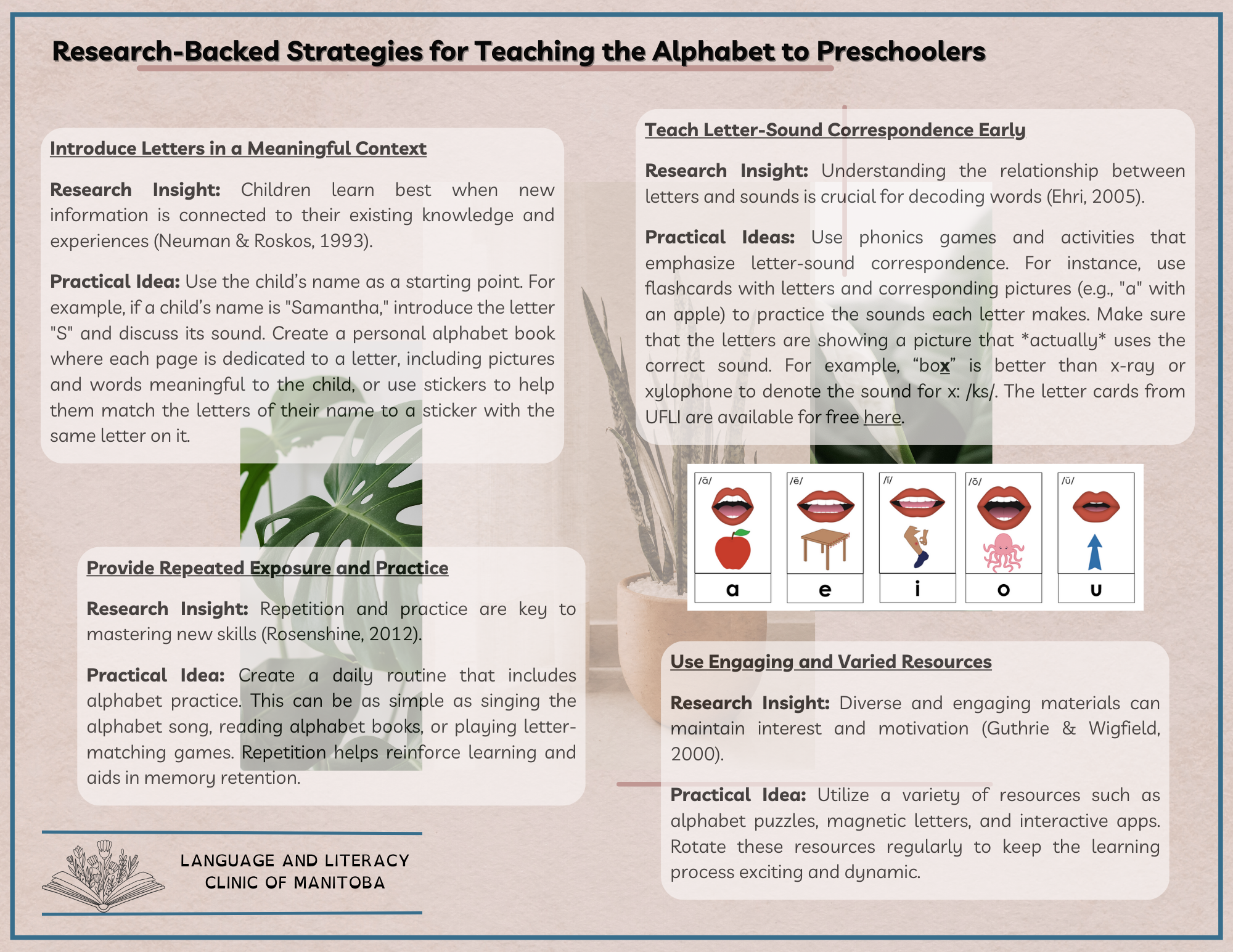
Alphabet Activities for Preschoolers
Alphabet Scavenger Hunt: Hide letters around the house or classroom and have children find them. Once found, they can practice saying the letter name and sound.
Alphabet Art: Encourage children to create artwork based on a specific letter. For instance, they could draw or paint a big "A" and then decorate it with pictures or items that start with "A."
Interactive Alphabet Chart: Create an alphabet chart with uppercase and lowercase letters. Prepare sticky notes with pictures that correspond to each letter. As you introduce each letter, have the child match the sticky note to the correct letter on the chart. Practice saying the letter, its sound, and the word on the sticky note. Review the chart daily, adding new words and pictures over time.
School-Age Students
Once a child has entered school, the goals and methods change. If a child does not know the letters in their name, we continue to start here, but with a more systematic and explicit focus. The goal is for all students to say all of the letter names and sounds automatically (i.e. with no hesitation) by the end of Kindergarten.
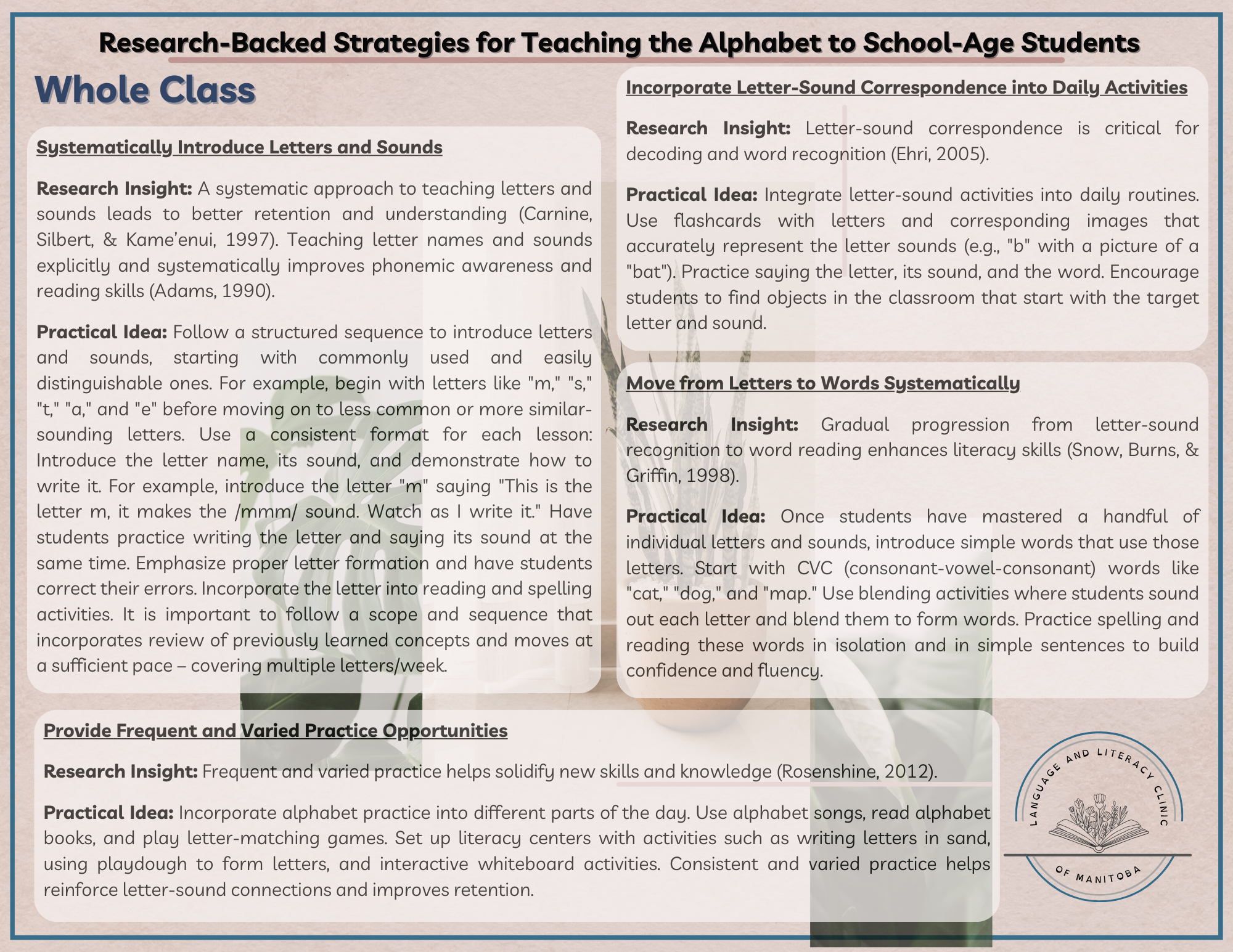
Small Group/1-1
For approximately 20% of your class, whole-group instruction will not be sufficient to help move their reading progress ahead. For those students, you will need to provide additional small group or 1-1 alphabet instruction. Use the activities below to provide more explicit teaching and practice.
Flashcards: Print these grapheme (letter) cards. Use them to focus on both letter names and letter sounds. Work for speed: the goal is immediate, effortless recognition.
When shown a card, the child’s response will be “letter name says letter sound(s)”. E.g., “m says /mmmm/” or “s says /ssss/ or /zzzz/”. See this Instagram video for information about how to accurately say each letter sound.
When the child makes an error, correct the error immediately. However, do not put that card at the back of the stack. Put it 1 or 2 cards back in the pile so they will see it again soon. Do the same when they respond slowly but correctly. If they get it right the second time, still refrain from putting it to the back. Rather, put it 4-5 cards behind the front card. This gives them further opportunity for reinforcement. Only correct items responded to instantly the first time go to the back of the deck.
Additional flashcard ideas: The child’s response when a card is pulled is the same as the instructions above.
· Place the cards in a bag and have them pull them out one at a time.
· Write the letters in a circle. Use a spinner to select the letter.
· Use plastic cups. Hide the cards under the cups. When you find them, say the name/sound. Alternatively, write letters on the cups, and hide an object under a cup. The child says the letter name or sound before picking up a cup to find the object. See this video.
· Whiteboard dice: (These can be found at most dollar stores, or on Amazon). Write the target letters on a die, roll the die and say the letter name/sound as quickly as possible.
After you have worked on seeing the letter and saying the letter name/sound, switch to the adult looking at the card, saying the sound, and the child writing the accurate letter. It is very important to correct for letter formation every time a letter is formed incorrectly. See this link for a list of letter formation cues. All letters MUST start at the top/middle line (never at the bottom). You will say the cue BEFORE they begin to write the letter for any letter that they regularly form improperly. For example, if they usually write b starting at the bottom, you will say, “down, up, around, and close” before they begin to write a b.
Example: Adult says, “/shhhh/. Child says, “/shhhh/ is: s (and writes the letter) h (and writes the letter).” There will be sounds that require the student to write multiple letters. E.g., Adult says “/k/”, Child says, “/k/ is c (and writes the letter) and k (and writes the letter).”

Word/Not-a-Word Game: After you have completed the above activities, create 3 stacks of cards. The middle stack is all of the vowels, and the outer 2 stacks are consonants. The child will move 1 card at a time and then decide if the word they have created is a real word or “not-a-word”. Take turns and keep score to see who can create more real words! See video for more information.
References
Adams, M. J. (1990). Beginning to Read: Thinking and Learning about Print. MIT Press.
Carnine, D. W., Silbert, J., & Kame’enui, E. J. (2009). Direct Instruction Reading 5th Edition. Prentice Hall.
Ehri, L. C. (2005). Learning to read words: Theory, findings, and issues. Scientific Studies of Reading, 9(2), 167-188.
Guthrie, J. T., & Wigfield, A. (2000). Engagement and motivation in reading. In Handbook of Reading Research (Vol. III, pp. 403-422). Lawrence Erlbaum Associates.
Neuman, S. B., & Roskos, K. (1993). Access to print for children of poverty: Differential effects of adult mediation and literacy-enriched play settings on environmental and functional print tasks. American Educational Research Journal, 30(1), 95-122.
Rosenshine, B. (2012). Principles of Instruction: Research-based strategies that all teachers should know. American Educator, 36(1), 12-19.
Snow, C. E., Burns, M. S., & Griffin, P. (1998). Preventing Reading Difficulties in Young Children. National Academy Press.
Resources
Want more support? Reach out for a free discovery call and we’ll set up a customized plan for you, your family, your colleagues, or your staff.
Follow us on Instagram to hear about all of the latest
research and tips to help YOUR child learn to read.
We can't wait to support you!