- Jul 31
Comprehension Isn't Taught—It's Built: The Language Comprehension Process and How We Teach It
- Britney | Language and Literacy Clinic of Manitoba
- 0 comments
What is Listening Comprehension, Really?
Language is language, regardless of how it gets into the brain. Whether it arrives through sound waves (listening) or through print (reading), the same language processing regions of the brain are activated. The modality changes but the comprehension process stays the same.
What does that mean for your classroom?
It means listening comprehension and reading comprehension use the same underlying language skills. They're not separate processes. They're the same process, arriving through different input channels.
According to the Simple View of Reading, reading comprehension is the product of two things: decoding (the ability to turn written symbols into sounds) and listening comprehension (language comprehension). This framework, supported by decades of research, shows us that if listening comprehension is weak, reading comprehension will be weak, no matter how strong decoding skills are (Gough & Tunmer, 1986).
So when we teach listening comprehension, we're teaching language comprehension. The same skills that help a student understand a sentence when they hear it will help them understand a sentence when they read it.
Language Comprehension is a Process, Not a Product
Castles, Rastle, and Nation (2018) define reading comprehension this way: "Reading comprehension is not a single entity that can be explained by a unified cognitive model. Instead, it is the orchestrated product of a set of linguistic and cognitive processes operating on text and interacting with background knowledge, features of the text, and the purpose and goals of the reading situation" (p. 28).
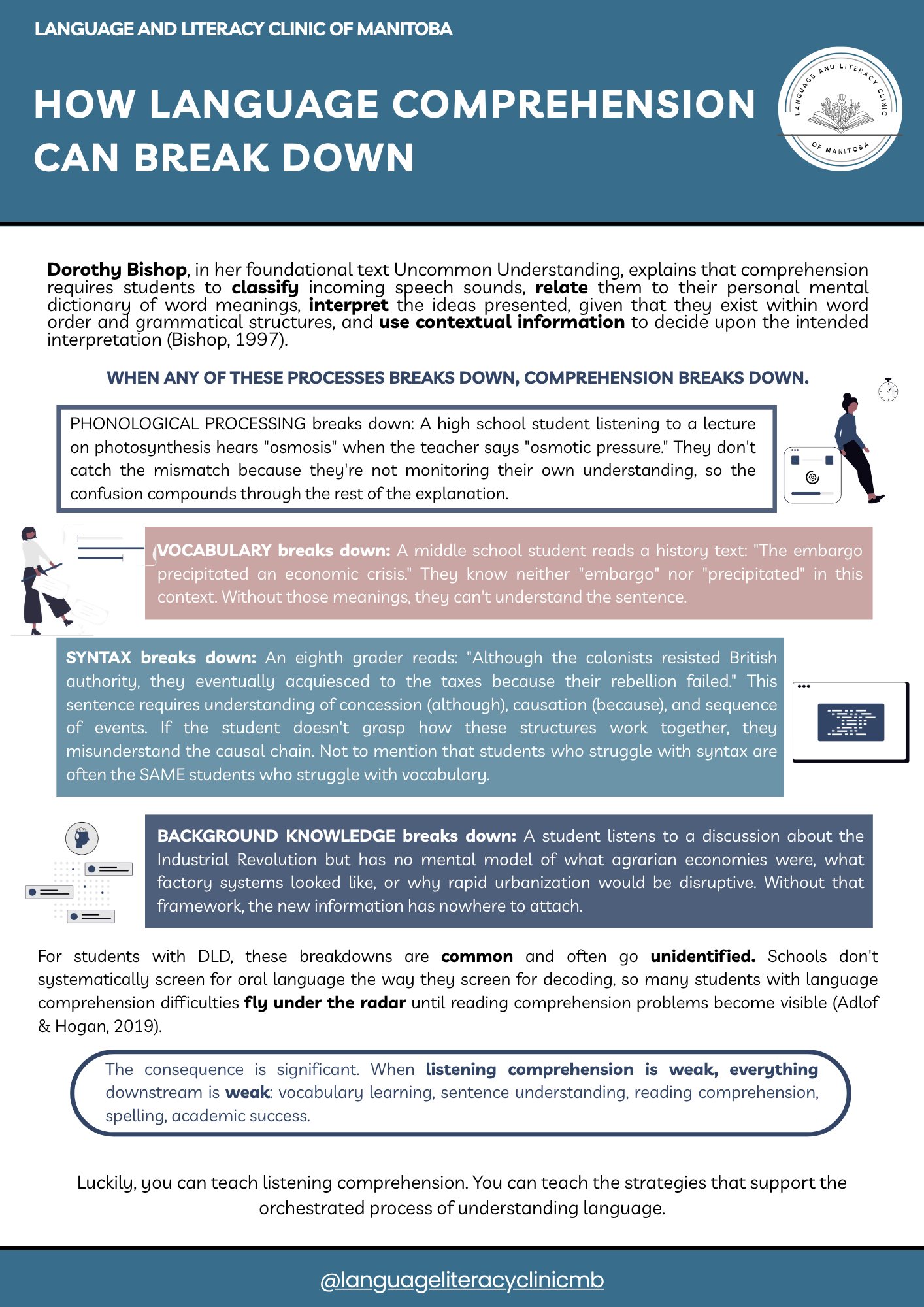
That definition applies equally to listening comprehension. It's not a single skill. It's not something a student either "has" or "doesn't have." It's an orchestrated process—multiple things happening at once, all working together.
When we know this, objectively we can see that we need to teach skills and processes in different ways.
With decoding, we can screen for skills. A student either knows the /sh/ sound or they don't. We can group students by skill level and teach discrete skills that build progressively.
With language comprehension, it doesn't work that way. There's no linear progression of skills students work through to become "proficient at comprehension." Instead, there are strategies we use as educators to support the development of the linguistic and cognitive processes happening inside the learner.
For example, in partner reading and paragraph shrinking, students are practicing fluency, but they're also developing the metacognitive strategy of comprehension monitoring—actively checking whether what they're reading makes sense. These are different things. One is a skill (fluency). One is a strategy we're teaching to help them monitor their own understanding (comprehension monitoring).
Language comprehension is a process students engage in while listening or reading. It's not something we can measure the same way we measure decoding. We can't give a test and say "Yes, they have comprehension" the way we can say "Yes, they can decode CVC words." Instead, we look at what students do while comprehending—the strategies they use, the connections they make, the questions they ask themselves.
The Strategies That Support Language Comprehension
According to the National Reading Panel (2000), these strategies have been determined to be effective when teaching comprehension:
Directly and explicitly teaching word meanings
Teaching comprehension monitoring
Teaching question generation and answering
Multiple-strategy instruction (e.g., syntax, morphology)
These are not separate from language instruction. They ARE language instruction. They're the strategies we use to help students develop the linguistic and cognitive processes that allow them to comprehend.
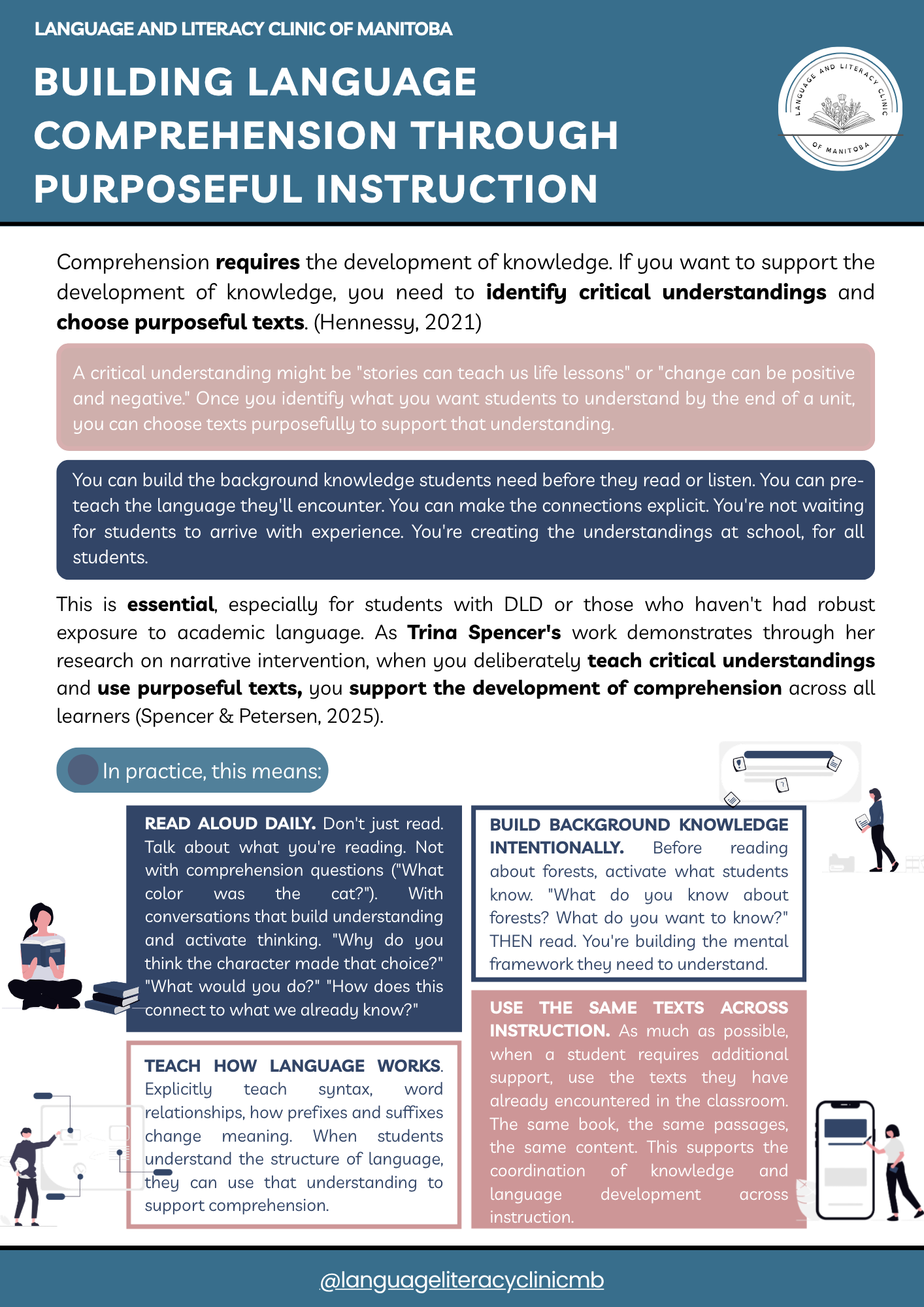
Directly and explicitly teaching word meanings means building vocabulary intentionally, not assuming students will pick up words incidentally. It means teaching words in context, across multiple exposures, with attention to relationships between words and how words are used in different situations.
Teaching comprehension monitoring means teaching students to check in with themselves while listening or reading. "Does this make sense?" "Have I heard this word before?" "What do I need to understand this?" These are metacognitive strategies—students actively thinking about their own thinking.
Teaching question generation and answering means moving beyond the comprehension questions we typically ask students ("Who was the main character?") to teaching students to generate their own questions. What do I want to know? What's confusing? What connects to what I already know?
Multiple-strategy instruction means teaching students how language works. How do prefixes and suffixes change meaning? How does word order change meaning? How do conjunctions show relationships between ideas? When students understand the architecture of language, they can use that understanding to support comprehension.
References
Adlof, S. M., & Hogan, T. P. (2019). If we don't look, we won't see: Measuring language development to inform literacy instruction. Perspectives on Language and Literacy, 45(2), 32–37.
Amjadi, A., & Talebi, S. H. (2024). Extending the efficacy of Collaborative Strategic Reading (CSR) in teaching reading strategies: A socio-cultural emotional perspective. Language Teaching Research, 28(2), 714–748. https://doi.org/10.1177/13621688211011501
Bishop, D. V. M. (1997). Uncommon understanding: Development and disorders of language comprehension. Psychology Press.
Castles, A., Rastle, K., & Nation, K. (2018). Ending the reading wars: Reading acquisition and developmental dyslexia. Psychological Science in the Public Interest, 19(1), 5–51. https://doi.org/10.1177/1529100618772271
Fuchs, L. S., Fuchs, D., Hosp, M. K., & Jenkins, J. R. (2001). Oral reading fluency as an indicator of reading competence: A framework for valid assessment. Journal of School Psychology, 39(5), 373–396.
Gough, P. B., & Tunmer, W. E. (1986). Decoding, reading, and reading disability. Remedial and Special Education, 7(1), 6–10. https://doi.org/10.1177/074193258607001002
Hennessy, N. L. (2021). The reading comprehension blueprint: Helping students make meaning from text [ERIC - ED610432 (https://eric.ed.gov/?id=ED610432)]. Brookes Publishing.
Khan, S., Ullah, S., Siraj, D., & Amjad, A. (2025). Examining classroom strategies: Reciprocal teaching and its effect on reading comprehension. SAGE Open, 15(1), 21582440251380709. https://doi.org/10.1177/21582440251380709
O'Hare, P., et al. (2023). Comparing the effectiveness of two reciprocal reading comprehension interventions for primary school pupils in disadvantaged schools. British Journal of Educational Psychology, 93, 1123–1145. https://doi.org/10.1111/bjep.12623