- Jun 30
(Oral) Language IS Literacy: A Complete Guide for Educators
- Britney | Language and Literacy Clinic of Manitoba
- 0 comments
The Skills You Think Are 'Just Speaking' Are Actually Reading and Writing Too
Your student reads the words. They can sound out (almost) every single one. But when you ask them what the passage means, they look blank, or they give you an answer that has NOTHING to do with the passage.
You assume they need more reading practice. If it’s fluency at play, that’s never going ot hurt. But we need to dig further to see if it’s JUST word-reading automaticity and fluency, or is it ACTUALLY language.
This is the mistake we make in schools. We focus heavily on decoding: phonics, blending, sound patterns, word parts, morphemes. These foundational skills are extremely important, but we often miss something ELSE that’s foundational: reading comprehension is built on language, not just decoding.
And if a student's language foundation is weak, reading comprehension will be weak. No amount of decoding practice will fix that.
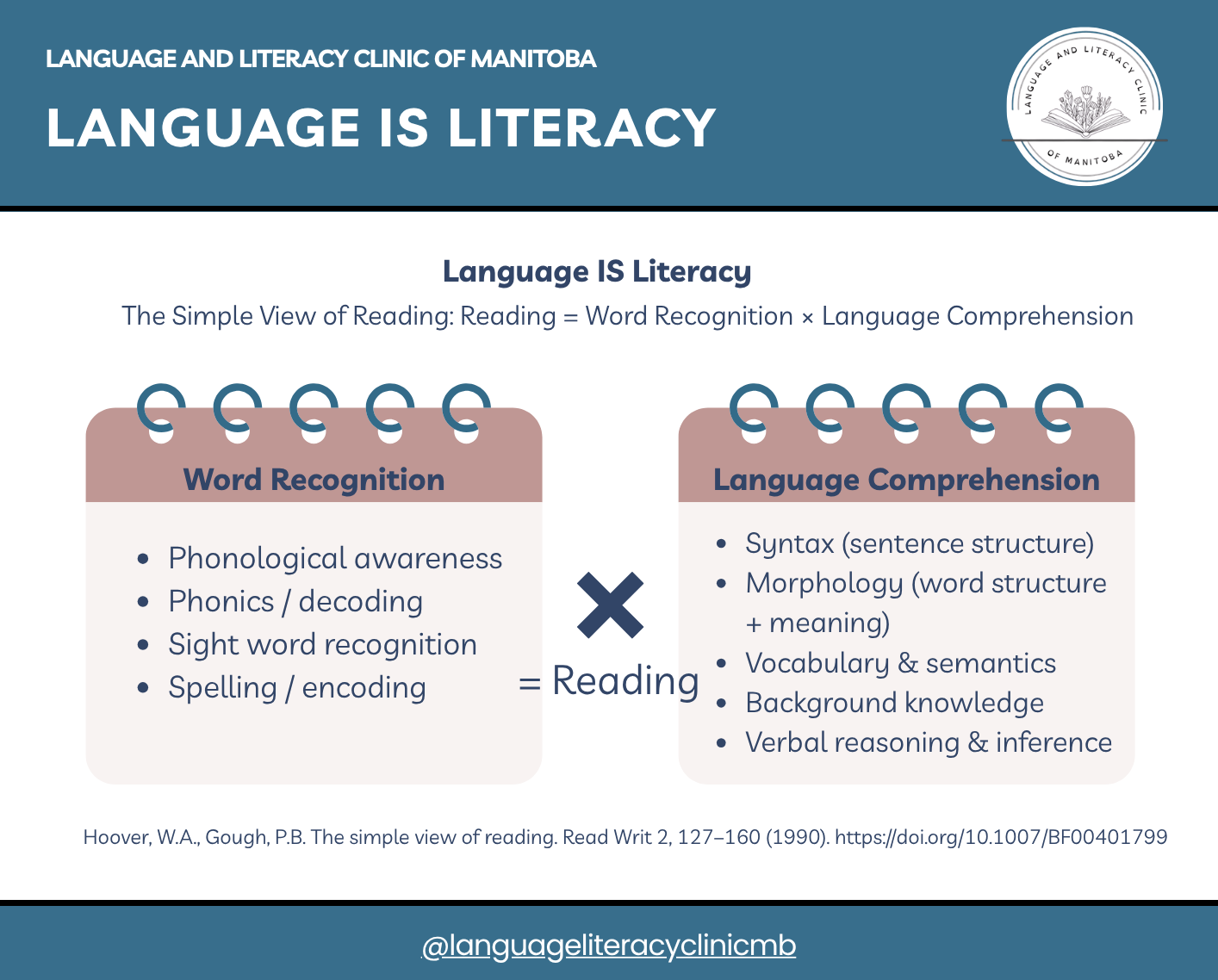
What is Oral Language?
Oral language isn't just "speaking and listening." It's the set of language skills that form the foundation for reading, writing, and thinking.
When you read, you're not just identifying words. You're understanding relationships between ideas. You're inferencing. You're connecting to background knowledge. You're recognizing nuance.
All of that depends on your language skills.
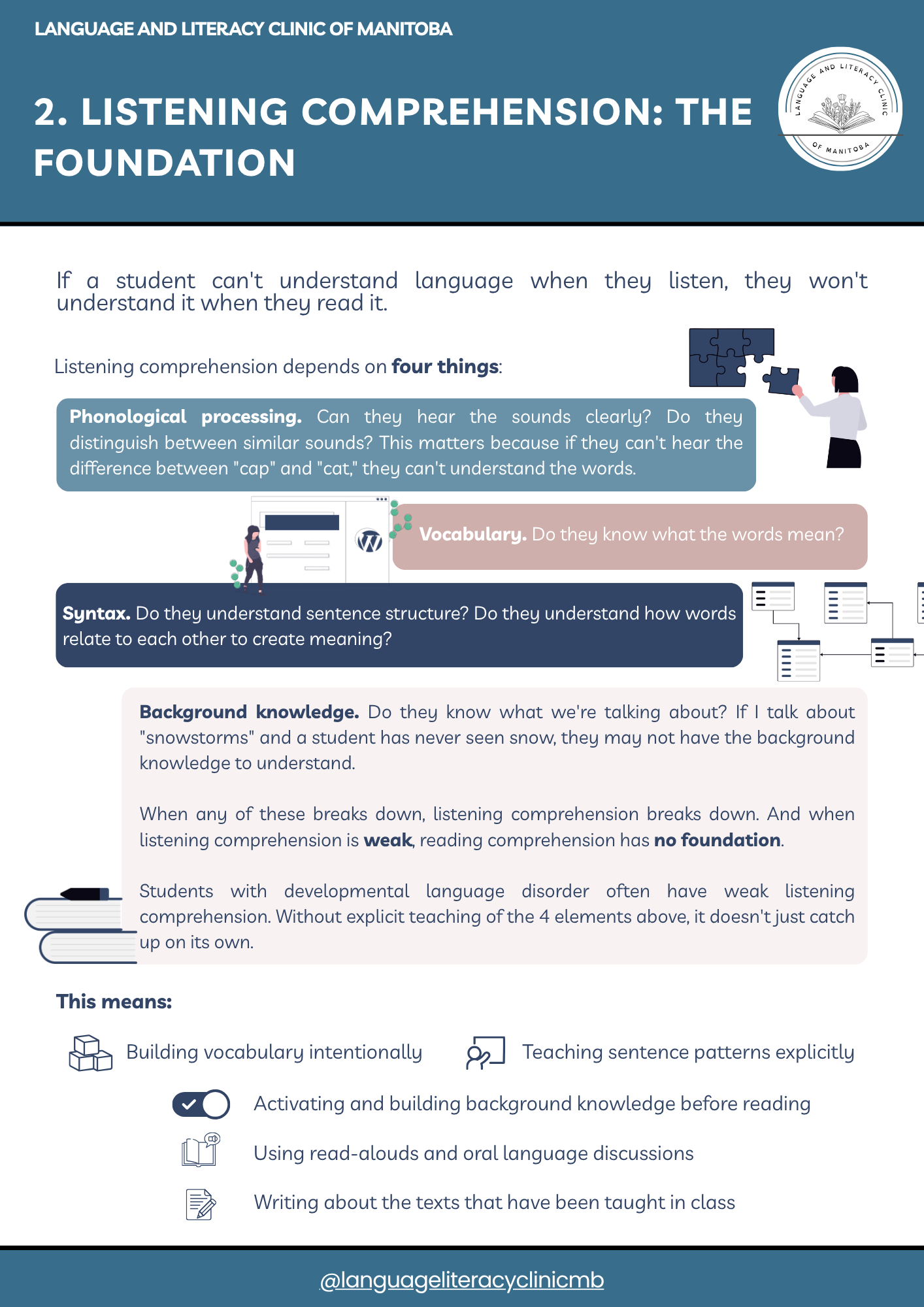
Your students' reading comprehension ceiling is their listening comprehension floor. That means: if they can't understand language when they hear it, they won't understand it when they read it.
This is why oral language instruction matters. It's not separate from literacy. It IS literacy.
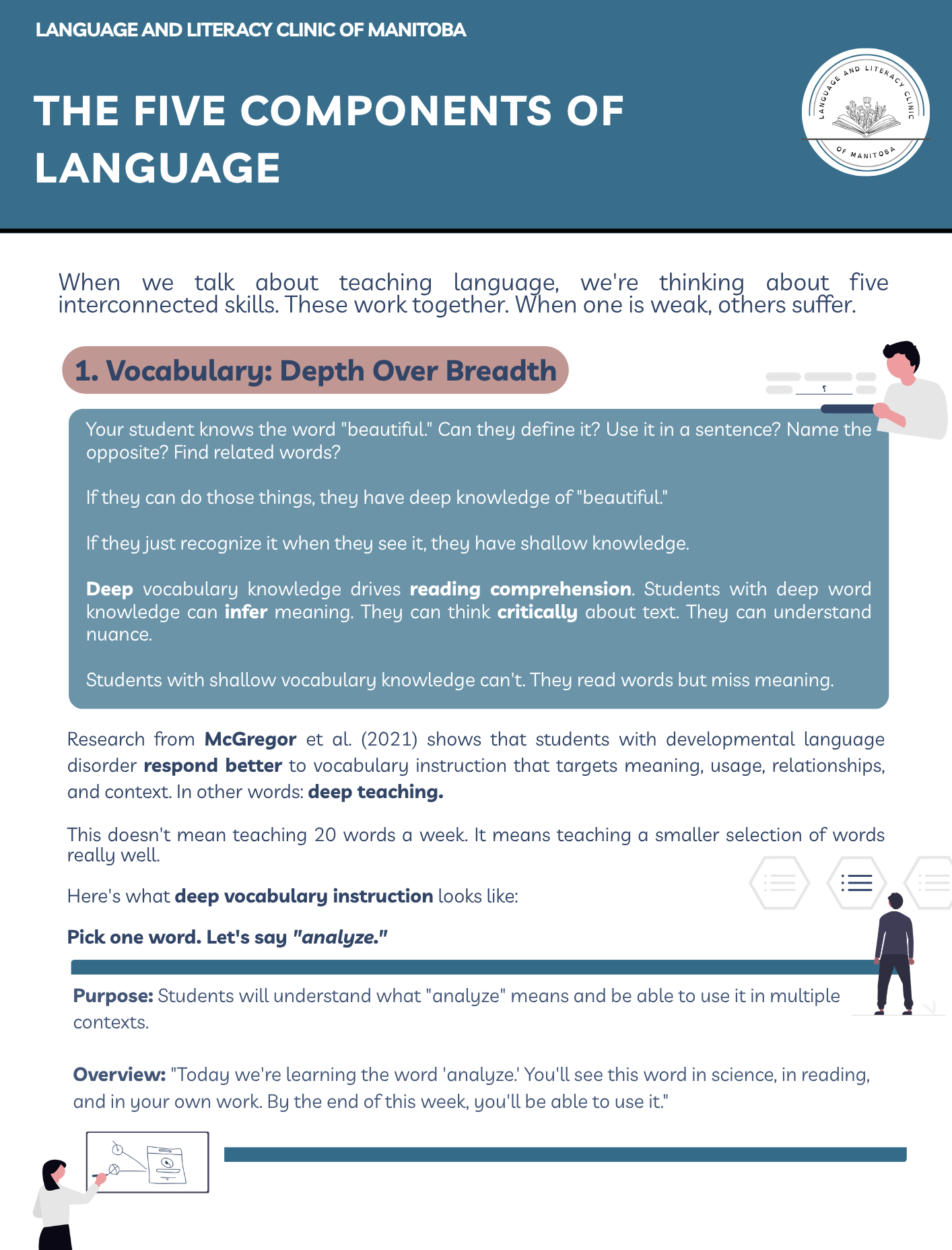
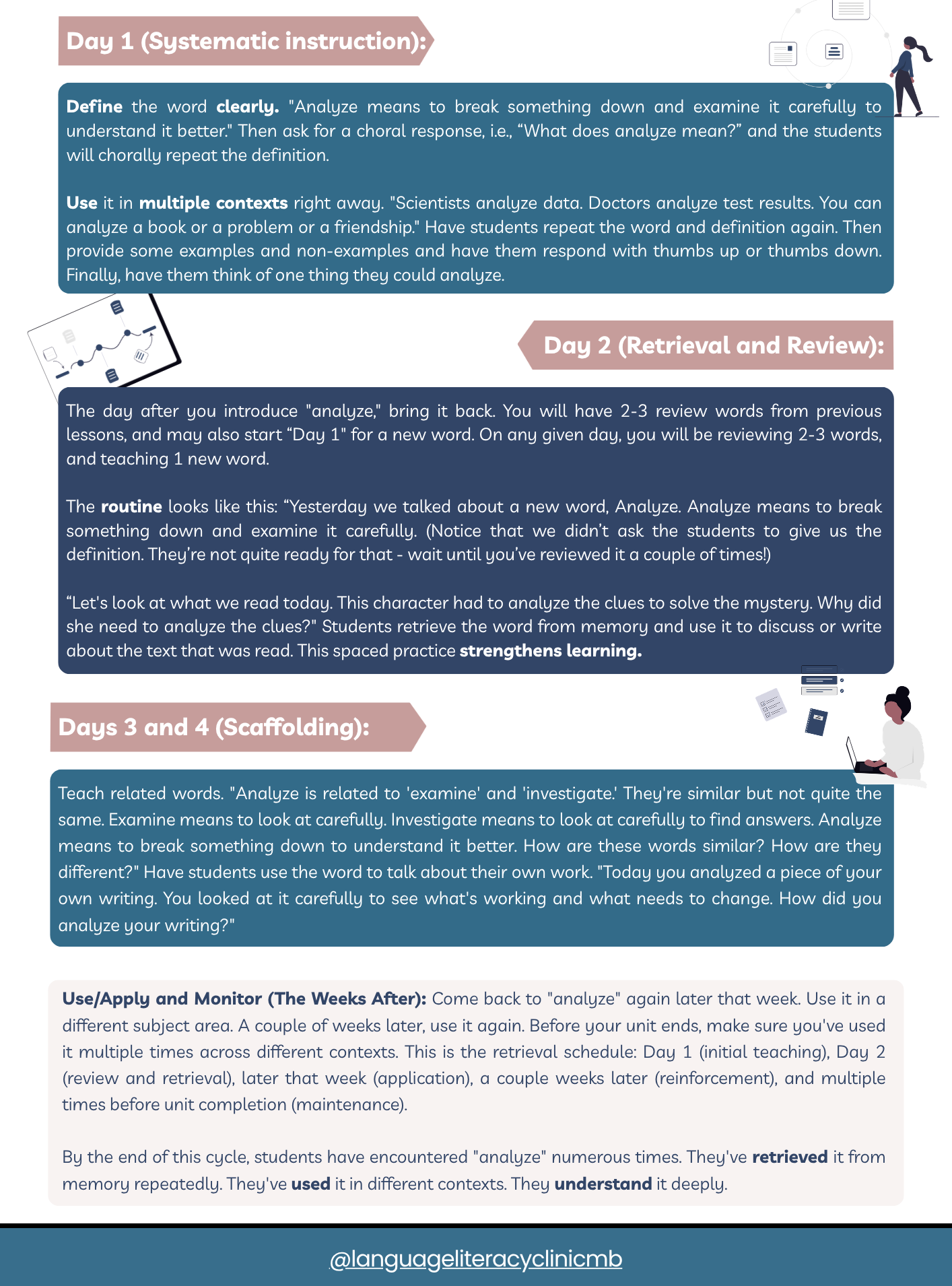
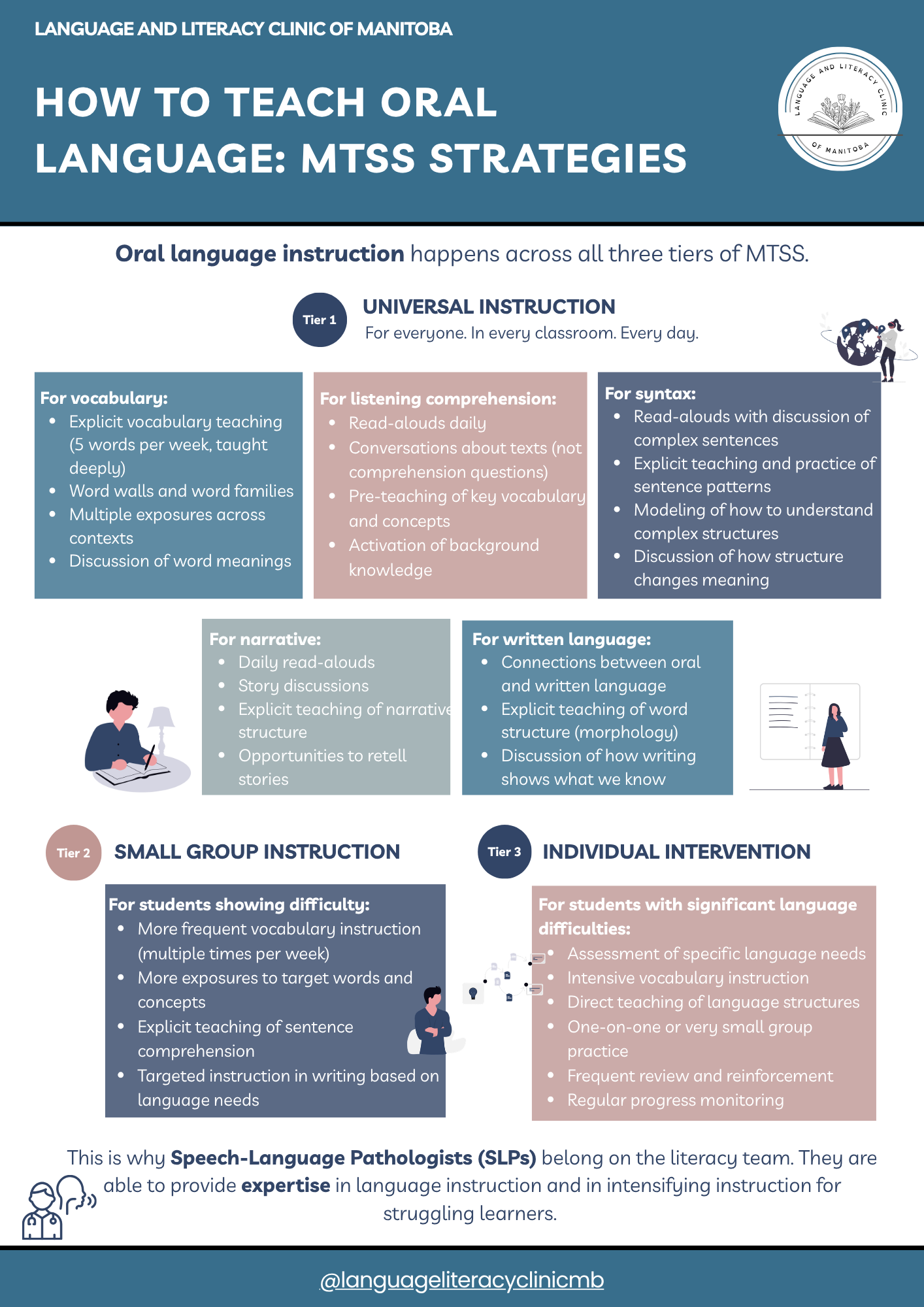
MTSS: This deep vocabulary teaching belongs in inside the classroom, as Tier 1 instruction, at ALL GRADES. But Tier 1 alone isn't enough for every student. Students with developmental language disorder (DLD), or students with dyslexia who haven’t been able to independently access grade-level text, may need a double dose of instruction. Students with DLD need significantly more repetitions of a word than their peers, whereas students with dyslexia generally have intact word-learning ability, but their vocabulary growth has been stunted by limited access. They need the same words being taught in Tier 1 to be re-taught, reviewed, and practiced more frequently in Tier 2 or Tier 3 settings. You select a smaller subset of Tier 1 words (so if a full unit covers 25 words, these students may get additional instruction in 5-7 of those words). They benefit from additional intensive vocabulary instruction on a carefully selected set of words. Over time, this intensive approach builds their vocabulary knowledge to where it should be for their grade level.
3. Syntax: The Structure of Comprehension
Sentence structure. Grammar. The way words connect to create meaning.
Does it matter for reading?
Absolutely.
Consider: "The cat chased the dog." vs. "The dog was chased chased by the cat."
Same meaning, but completely different syntax.
Complex sentences require students to hold multiple ideas and understand relationships between them.
"Although the students were tired, they stayed focused because they wanted to finish the project."
This sentence requires understanding of: concession (although), causation (because), and intention (wanted to). Those words are cohesive devices that force the reader to use their inference skills. For students with DLD, syntax can make reading AND listening comprehension challenging.
Research from Balthazar et al. (2020) and Ebbels et al. (2019) shows that explicit grammatical intervention improves reading comprehension, because teaching students how language works teaches them how to understand language.
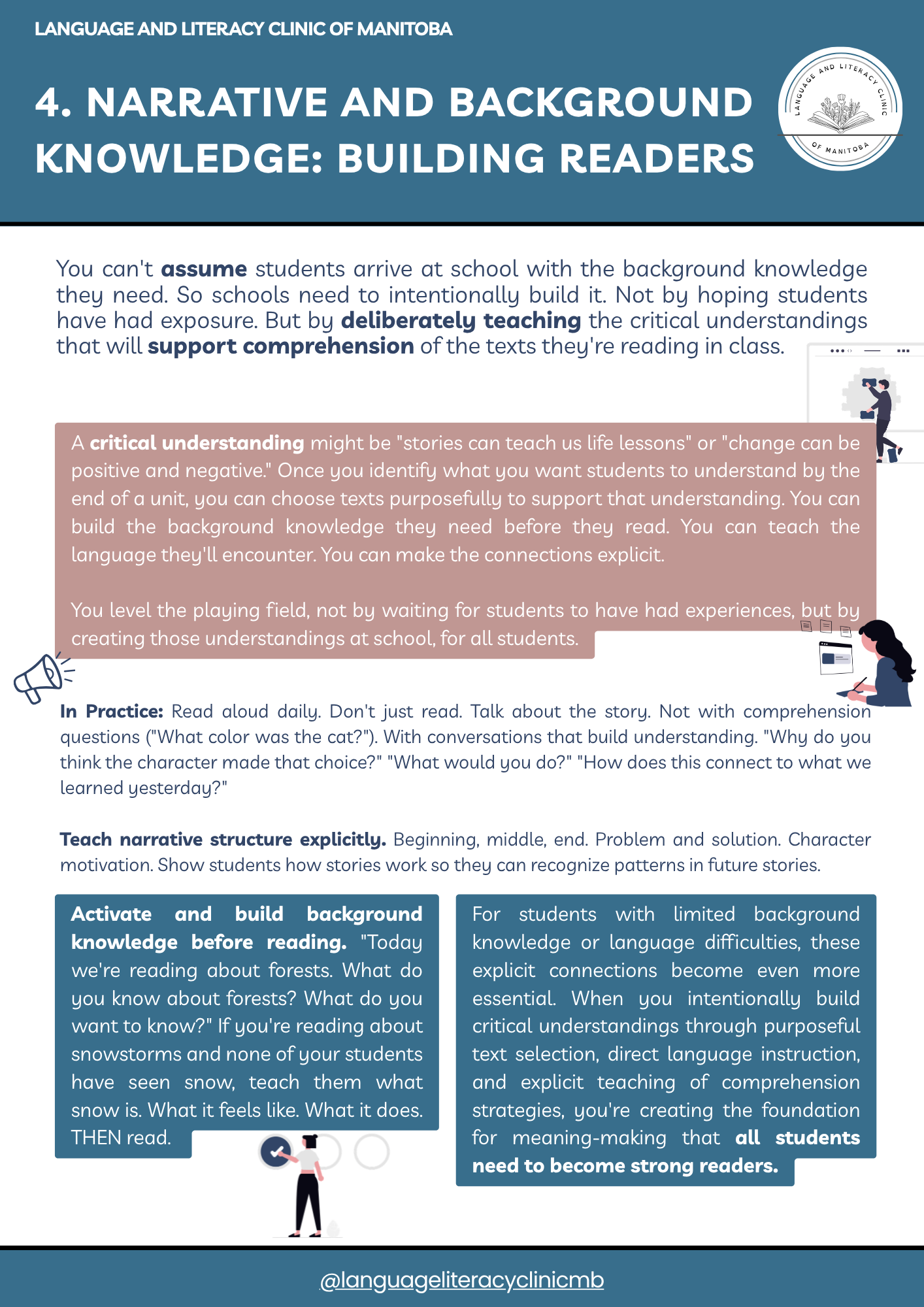
5. Written Language: Expression of Language Understanding
Writing is hard. It requires: planning what you want to say, spelling accurately, using correct grammar, and organizing ideas.
These are all language skills. Not "writing skills." Language skills.
When a student struggles with organization, spelling, or grammar in writing, they're often struggling because they don't have a deep understanding of language.
Research from Buil-Legaz et al. (2023) shows that children with early oral language difficulties have significantly weaker spelling, especially with complex words, longer words, and morphologically complex words.
To spell a word, you need to know what it means, understand its structure, remember how it sounds, and relate it to other words.These are all language skills.
If a student's oral language foundation is weak, their written language will be weak.
The solution is to teach language explicitly. Build vocabulary. Teach word structure (morphology). Teach sentence structure (syntax). Make connections between spoken and written language explicit.
When students have strong oral language, writing becomes easier.
Why This Matters for Students with DLD and Dyslexia
Both students with DLD and students with dyslexia need strong language foundations to understand what they read.
The student with DLD might decode okay, but struggle with comprehension because their language foundation is weak.
The student with dyslexia might struggle with decoding, but once they decode, they still need strong language skills to understand.
For both groups, explicit language instruction is essential. These students need more explicit teaching than typical learners. They need a higher dose. They need more opportunities to respond. They need connections made explicit.
And they need this from Day 1. Not as remediation for struggling readers. As part of the literacy instruction for all students, with intensity adjusted based on need.
The Brain Science: Why This Matters
Research from Turesky et al. (2025) shows that early language skills predict literacy development. When we look at brain development from infancy through school age, we see that phonological processing and oral language skills in preschool predict decoding and word reading skills in kindergarten and second grade.
In other words: your students' reading skills are built on their oral language foundation.
We can't wait until second grade to address language difficulties. Language development starts early. Early language experiences shape brain development. And brain development shapes literacy.
So if we want strong readers, we start with strong language. Not in second grade. From the beginning.
References:
Balthazar, C. H., Ebbels, S., & Zwitserlood, R. (2020). Explicit grammatical intervention for developmental language disorder: Three approaches. Language, Speech, and Hearing Services in Schools, 51(2), 226–246. https://doi.org/10.1044/2019_LSHSS-19-00046
Brooks Newsome, K., Nix Berens, K., Ghezzi, P. M., Aninao, T., & Newsome, W. D. (2014). Training relational language to improve reading comprehension. European Journal of Behavior Analysis, 15(2), 165–197. https://doi.org/10.1080/15021149.2014.11434512
Buil-Legaz, L., Suárez-Coalla, P., Santamarina-Rabanal, L., Martínez-García, C., Rodríguez-Ferreiro, J., & Cuetos, F. (2023). Spelling problems after early oral language difficulties. International Journal of Language & Communication Disorders, 58(3), 756–764. https://doi.org/10.1111/1460-6984.12819
Ebbels, S. H., McCartney, E., Slonims, V., Dockrell, J. E., & Norbury, C. F. (2019). Evidence-based pathways to intervention for children with language disorders. International Journal of Language & Communication Disorders, 54(1), 3–19. https://doi.org/10.1111/1460-6984.12387
McGregor, K. K., Van Horne, A. O., Curran, M., Cook, S. W., & Cole, R. (2021). The challenge of rich vocabulary instruction for children with developmental language disorder. Language, Speech, and Hearing Services in Schools, 52(2), 467–484. https://doi.org/10.1044/2020_LSHSS-20-00110
Smith, R., Snow, P., Serry, T., & Hammond, L. (2026). The importance of knowledge for reading comprehension: A quasi-experimental investigation. Reading Psychology, 1–27. https://doi.org/10.1080/02702711.2026.2644971
Turesky, T. K., Escalante, E. S., Loh, M., & Gaab, N. (2025). Longitudinal trajectories of brain development from infancy to school age and their relationship with literacy development. Proceedings of the National Academy of Sciences, 122(24), e2414598122. https://doi.org/10.1073/pnas.2414598122