- Aug 28
Evidence-Based Interventions: Teaching Language Comprehension
- Britney | Language and Literacy Clinic of Manitoba
- 0 comments
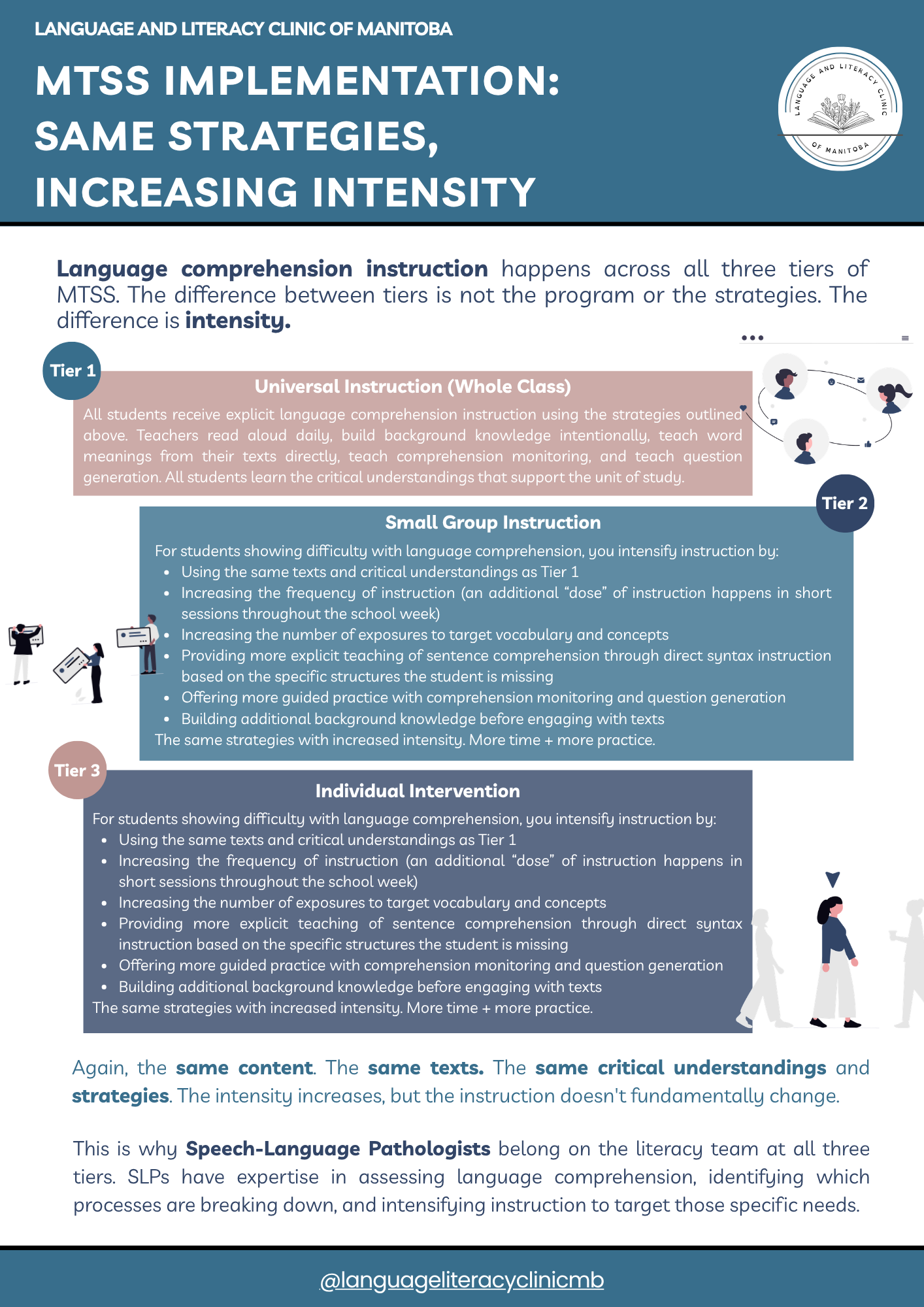
Teaching the strategies that support comprehension doesn't require new programs or completely overhauling instruction. Several evidence-based interventions have strong research backing for teaching listening and reading comprehension across all three tiers of MTSS.
Reciprocal Teaching is one of the most extensively researched comprehension interventions. Originally developed by Palinscar and Brown, it structures student-teacher dialogue around four key comprehension strategies: generating questions, summarizing, predicting, and clarifying. Recent research from 2023 and 2025 shows reciprocal teaching produces measurable gains in reading comprehension, with particularly strong effects for students with learning difficulties. Multi-level analyses show students receiving reciprocal teaching instruction score significantly higher on standardized reading comprehension assessments compared to peers in comparison classrooms (O'Hare et al., 2023; Khan et al., 2025).
Collaborative Strategic Reading (CSR) is another comprehension intervention with strong efficacy data. CSR teaches students to preview texts before reading, click (monitor comprehension) during reading, and clunk (work through difficult vocabulary) while reading. It emphasizes collaborative, guided practice. Research shows students receiving CSR instruction score significantly higher on comprehension measures, with effect sizes ranging from g = 0.18 to g = 0.43 depending on the study design. CSR works well across tiers because it can be delivered whole-class (Tier 1) or in small groups (Tier 2) with the same instructional framework (Vaughn et al., 2011; Amjadi & Talebi, 2024).
Story Champs, developed by Trina Spencer and Doug Petersen, is a narrative-based language intervention specifically designed to teach oral language comprehension and production. The intervention embeds vocabulary instruction into narrative contexts and tracks comprehension, inferences, language structures, and decoding through progress monitoring tools (CUBED—Comprehension and Understanding Based on Elevated Discourse). Research shows Story Champs has significant impact on vocabulary acquisition and narrative comprehension for students at risk for reading comprehension difficulty, and it's easily implemented across all three tiers of instruction (Spencer & Petersen, 2025; Spencer et al., 2024).
Narrative-Based Syntax Intervention (NBSI), also developed by Spencer and Petersen, targets syntactic complexity and discourse-level language skills, particularly for students with developmental language disorder. This intervention is grounded in narrative contexts and focuses on helping students understand how language structures work together to create meaning. NBSI aligns well with The Syntax Project, another free syntax instruction and intervention resource (Spencer & Petersen, 2020).
Partner Reading with Paragraph Shrinking combines fluency practice with comprehension monitoring. During partner reading, one student reads a paragraph aloud while the other listens and monitors understanding. Then they work together to summarize the paragraph in one sentence (paragraph shrinking). This strategy builds both fluency and active comprehension monitoring—students are forced to check whether they understood what they just read (Fuchs et al., 2001).
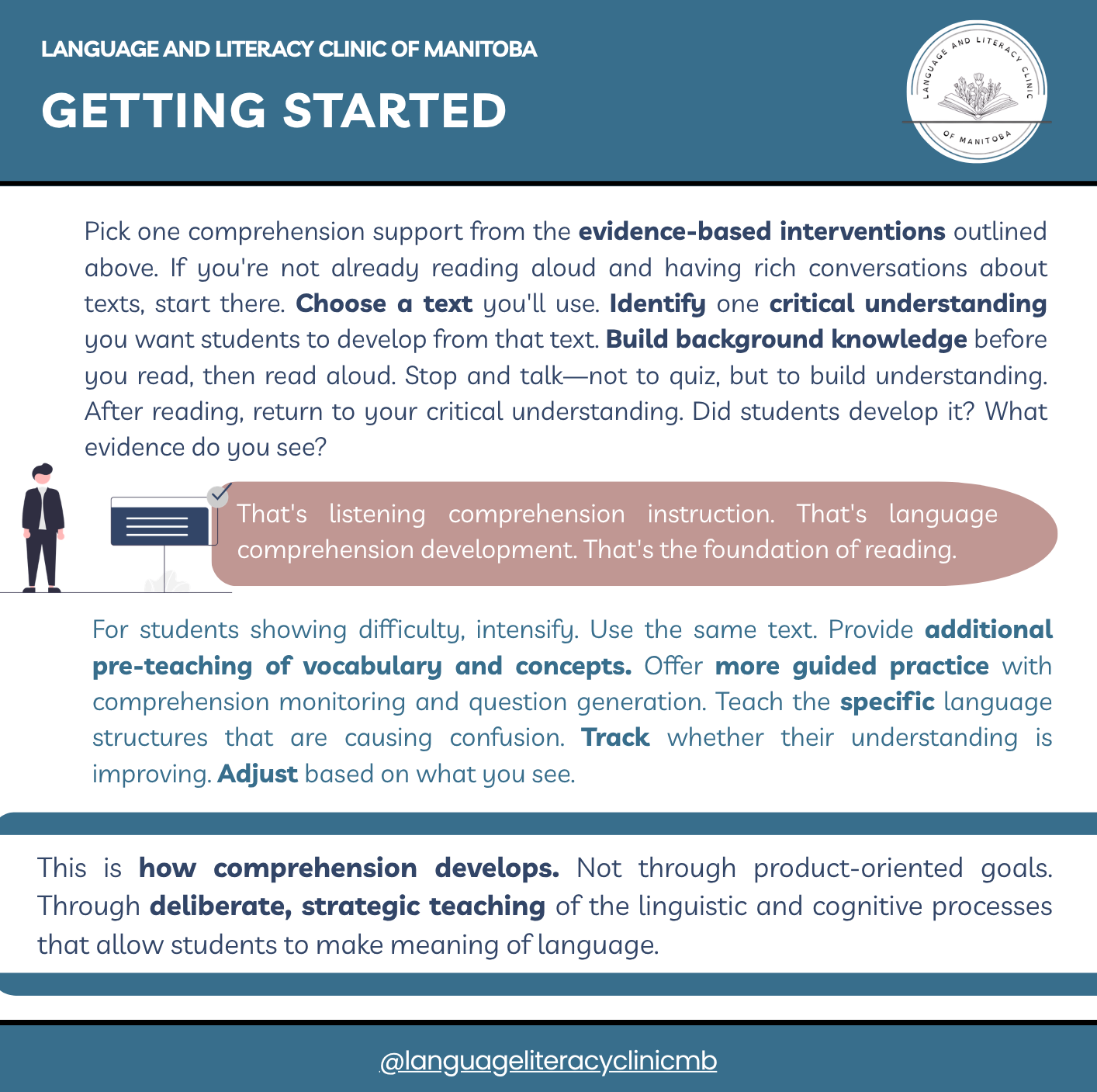
What these interventions share is that they teach the underlying strategies that support language comprehension. They're not one-off comprehension lessons. They're systematic approaches to teaching students how to engage with text and monitor their own understanding.
Progress Monitoring: A Process-Oriented Approach
In schools, we're used to product-oriented goals. "Student will answer comprehension questions with 80% accuracy." These goals measure an outcome, not a process.
But language comprehension is a process, not a product. It's something students do WHILE listening or reading, not something they "achieve."
Instead of measuring products, measure processes. Use rubrics that show how students are engaging with texts. Are they asking themselves questions? Are they monitoring whether text makes sense? Are they connecting new information to background knowledge? Are they using the language strategies you're teaching?
Both student self-rating and educator rating provide valuable information. A student reflecting on their own comprehension monitoring ("Did I check whether that made sense?") is engaging in metacognition. That's the process you're developing.
References
Adlof, S. M., & Hogan, T. P. (2019). If we don't look, we won't see: Measuring language development to inform literacy instruction. Perspectives on Language and Literacy, 45(2), 32–37.
Amjadi, A., & Talebi, S. H. (2024). Extending the efficacy of Collaborative Strategic Reading (CSR) in teaching reading strategies: A socio-cultural emotional perspective. Language Teaching Research, 28(2), 714–748. https://doi.org/10.1177/13621688211011501
Bishop, D. V. M. (1997). Uncommon understanding: Development and disorders of language comprehension. Psychology Press.
Castles, A., Rastle, K., & Nation, K. (2018). Ending the reading wars: Reading acquisition and developmental dyslexia. Psychological Science in the Public Interest, 19(1), 5–51. https://doi.org/10.1177/1529100618772271
Fuchs, L. S., Fuchs, D., Hosp, M. K., & Jenkins, J. R. (2001). Oral reading fluency as an indicator of reading competence: A framework for valid assessment. Journal of School Psychology, 39(5), 373–396.
Gough, P. B., & Tunmer, W. E. (1986). Decoding, reading, and reading disability. Remedial and Special Education, 7(1), 6–10. https://doi.org/10.1177/074193258607001002
Hennessy, N. L. (2021). The reading comprehension blueprint: Helping students make meaning from text [ERIC - ED610432 (https://eric.ed.gov/?id=ED610432)]. Brookes Publishing.
Khan, S., Ullah, S., Siraj, D., & Amjad, A. (2025). Examining classroom strategies: Reciprocal teaching and its effect on reading comprehension. SAGE Open, 15(1), 21582440251380709. https://doi.org/10.1177/21582440251380709
O'Hare, P., et al. (2023). Comparing the effectiveness of two reciprocal reading comprehension interventions for primary school pupils in disadvantaged schools. British Journal of Educational Psychology, 93, 1123–1145. https://doi.org/10.1111/bjep.12623
Spencer, T. D., & Petersen, D. B. (2020). Narrative-based syntax intervention. In R. Paul & P. Cascella (Eds.), Introduction to Clinical Methods in Communication Disorders (4th ed., pp. 279–296). Pearson.
Spencer, T. D., & Petersen, D. B. (2025). Assessment to instruction: A closer look at language comprehension. Intervention for School and Clinic. [Manuscript in press].
Vaughn, S., Klingner, J. K., Swanson, E. A., Boardman, A. G., Roberts, G., Mohammed, S. S., & Stillman-Spisak, S. J. (2011). Efficacy of collaborative strategic reading with middle school students. American Educational Research Journal, 48(4), 938–964. https://doi.org/10.3189/aera.2011.48.4.938